


A support bot that can quote your refund policy word for word and a bot that can actually issue the refund look identical in a demo. Both sit behind a chat box. Both sound confident. Underneath, they are different kinds of software, with different costs, different risks and very different ways of failing.
The first is RAG. The second is an AI agent. And if a third system spots a pattern in those refunds, flags the faulty batch, pauses the listing and drafts a note to the supplier without being asked, you are looking at agentic AI.
The distinction is getting harder to see, not easier. Gartner estimates that only about 130 of the thousands of vendors claiming agentic AI actually offer it, and predicts that more than 40% of agentic AI projects will be cancelled by the end of 2027. In our view, many of those failures start the same way: a team reaches for the wrong pattern for the problem in front of it.
This article explains what RAG, AI agents and agentic AI each do and where the line between them falls. It also covers how each one fails and how to choose between them.
The short version: RAG (retrieval augmented generation) lets a model look things up in your data before it answers. An AI agent lets a model choose its own steps and call tools to finish a task. Agentic AI is the wider system in which several agents plan, coordinate and work toward a goal inside limits you set. The quickest way to tell them apart is to ask who owns the control flow: your code, the model, or a planner with a team of agents.
Why do RAG, AI agents and agentic AI get confused?
They get confused because they nest inside each other, and because the market has an incentive to blur them.
Most AI agents use retrieval, so RAG shows up inside agents. Every agentic AI system is assembled from agents, so agents show up inside agentic AI. Read three vendor decks in a row and the same diagram appears under three names.
The blurring is also commercial. Gartner calls it “agent washing”: rebranding assistants, chatbots and RPA scripts as agentic AI without adding real agentic capability.
An analogy helps, and we will keep it for the rest of this guide. Picture a large airport on the night a storm cancels forty flights.
- The information desk can tell you exactly what the rebooking policy says. It cannot rebook you.
- The gate agent can put you on the 6:10 a.m. departure, because she has access to the reservation system and the authority to use it.
- The operations control centre is re-planning the whole night: crews, gates, connections, hotel vouchers. Nobody there waits to be told each step. They work toward one goal and adjust as conditions change.
Those are RAG, an AI agent and agentic AI, in that order.
What is RAG (retrieval augmented generation)?
RAG, short for retrieval augmented generation, is a technique that makes a language model look up relevant information from an external source before it answers. The response is grounded in documents you control instead of relying only on what the model absorbed during training.
The term comes from a 2020 paper by Patrick Lewis and eleven co-authors, presented at NeurIPS that year. They paired a model's built-in “parametric” memory with a searchable “non-parametric” memory, a dense vector index of Wikipedia, and found the output was more specific and more factual than a model working from memory alone. The paper also named two problems RAG is still used to solve: showing where an answer came from, and updating what a model knows without retraining it.
The whole pattern is a fixed sequence: search the index for passages that match the question, add them to the prompt, and ask the model to answer from them.
One retrieval, one model call, no decisions. That is why RAG is cheap, fast and easy to test. It is the airport's information desk: it reads you the answer from the live board and can point to the screen it read from.
How does RAG architecture work?
A basic RAG architecture has four steps:
- Index. Documents are split into chunks, converted into embeddings and stored in a vector or hybrid search index.
- Retrieve. The question is embedded and matched against the index, and the top-ranked chunks are pulled.
- Augment. Those chunks are placed into the prompt alongside the question.
- Generate. The model writes an answer from that supplied context, ideally with citations back to the chunks.
RAG patterns worth knowing
A production RAG implementation rarely stays that simple. The RAG patterns teams meet most often are:
- Hybrid search with reranking. Vector search is weak on exact identifiers such as part numbers and error codes, so keyword search runs alongside it and a reranker reorders the merged results.
- Multihop RAG, which chains several retrievals when one lookup cannot answer the question.
- RAG-fusion, which rewrites the question several ways, runs each search and merges the ranked results.
- Agentic RAG, where an agent decides what to search, judges the results and searches again if they fall short.
Where RAG breaks, and how to test it
RAG is read-only: it can quote the refund policy but cannot issue the refund. Inside that limit, most failures are retrieval failures. A chunk boundary splits the answer in two. The index is a week stale. Twenty chunks are stuffed into the prompt and the right one is drowned out.
Test the two halves separately. For retrieval, build a labelled question set and measure how often the right chunk appears in the top results. For generation, check that every claim in the answer is supported by the retrieved text. When a RAG system gives bad answers, look at retrieval first. A bigger RAG model rarely fixes a missing chunk.
What are AI agents?
An AI agent is software that uses a language model to decide which steps to take and which tools to call in order to finish a task. Unlike a chatbot, it does not stop at a reply. It acts, checks the result and continues until the job is done or a limit is reached.
Anthropic's engineering guidance draws the line that matters. In a workflow, your code fixes the path and the model fills in the steps. In an agent, the model directs its own process and chooses its own tools. Stripped down, an agent is a loop: the model picks an action, a tool carries it out, the model reads the result and decides again, until the task is done or a step limit is hit.
In airport terms this is the gate agent. She does not recite the rebooking policy. She opens the reservation system, finds a seat and reissues the ticket, within the limits of one desk and a defined set of systems.
What the loop implies
The loop is simple to describe. Everything hard about AI agents follows from it.
Start with control flow. Because the model chooses each step, the same input can take a different path on every run, which means you cannot unit-test an agent the way you test a function. Cost behaves differently too. Each call resends the accumulated history, so token spend climbs faster than the step count.
Then there are the tools. An agent knows a tool only through its name, description and schema, so the tool definitions are its real API surface, and a vague one causes more wrong actions than a vague prompt. Tools that write need extra care. A retry must not pay an invoice twice, so write operations should be idempotent or sit behind an approval.
Finally, errors compound. As a rough illustration, if each step is right 95% of the time, a ten-step task finishes cleanly only about 60% of the time (0.95 to the power of 10). Long chains need checkpoints, not just better prompts.
Take a disputed supplier invoice. RAG can tell an accounts payable clerk what the contract says about payment terms. An AI agent can pull the purchase order, compare it with the invoice, spot the mismatch and draft the credit note for approval.
What the data says about coding agents
Coding agents show the compounding problem in numbers. CodeRabbit's December 2025 study of 470 open-source pull requests found that AI-co-authored changes averaged 10.83 issues each against 6.45 for human-only changes, roughly 1.7 times as many. Logic and correctness issues were 75% more common, and some security issues appeared up to 2.74 times as often. CodeRabbit notes it could not confirm authorship of every pull request, so treat the figures as directional. The direction is still clear: AI agents raise output, and the review burden rises with it.
How to test an agent
Judge the end state, not the transcript. Run each task many times in a sandbox, check whether the final state is correct, and track success rate, steps taken and cost per task. Then set a step limit and a spend limit, because an agent without either will eventually find a way to need them.
What is agentic AI?
Agentic AI describes systems in which one or more AI agents plan, make decisions and coordinate multi-step work toward a goal, with people supervising the outcome instead of directing each step. “Agent” names a component. “Agentic” describes how the whole system behaves.
Where an agent is a loop, an agentic system is a loop of loops with a planner on top. The planner breaks the goal into tasks, routes each one to a specialist agent, records the results in shared state, pauses for human approval where policy requires it, and re-plans as new information arrives.
This is the airport's operations control centre. No single person there rebooks a passenger. The centre holds the goal, splits the work among specialists, watches what comes back and re-plans when the weather shifts again.
What does an agentic AI architecture add?
An agentic AI architecture adds five things on top of individual agents:
- Orchestration. A planner breaks a goal into tasks and routes them. Anthropic's guidance names the common shapes: routing, parallel workers, orchestrator-workers and evaluator-optimizer loops. Agentic AI orchestration is mostly a choice among these.
- Shared state. Agents read and write a common record of the work, so a handoff does not lose context and two agents do not overwrite each other.
- Standard connections. Protocols such as the Model Context Protocol (MCP) give agents a consistent way to reach tools and data.
- Guardrails. Per-agent permissions, approval gates, budgets and audit trails decide what agents may do without asking.
- Observability. Every model call, tool call and handoff is traced. Without traces, a failed run across four agents cannot be debugged.
Return to the invoice dispute. In agentic AI workflows, an intake agent classifies the dispute, a matching agent reconciles the documents, a policy agent uses RAG to check contract terms, and a resolution agent drafts the outcome. Anything above a set value pauses for a human approver. Nobody scripted that exact sequence in advance.
Software delivery is one of the clearest places to see this pattern at work. WaveMaker's agentic app generation platform uses specialised agents for separate jobs, such as turning Figma designs into components, wiring APIs and setting up security, and coordinates them toward a singular goal to produce a working web or mobile application. The agents produce a stack-agnostic app markup rather than final code, and deterministic generators turn that markup into Angular, React or React Native. Developers can review changes before they are committed, and approval gates pause the agents before irreversible steps. It is agentic AI with the guardrails built into the architecture rather than added afterwards.
Where agentic AI struggles
Coordination multiplies both capability and failure. More agents mean more tokens, more handoffs and more places for an error to travel, and concurrent runs are far harder to reproduce than a single loop. Governance is the larger problem. Gartner predicted in May 2026 that by 2027, 40% of enterprises will demote or decommission autonomous AI agents because of governance gaps found only after a production incident.
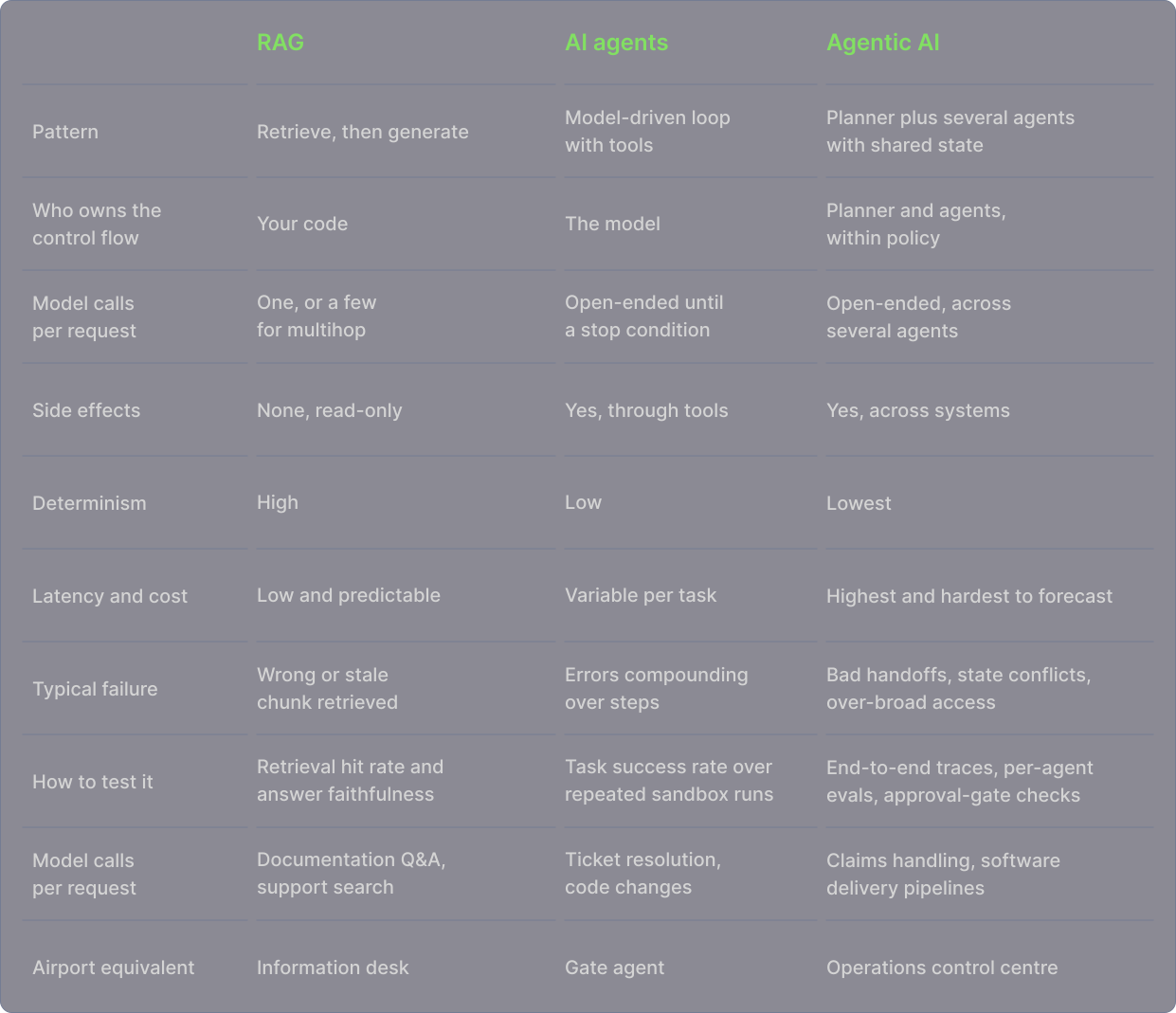
RAG vs AI agents vs agentic AI: how do they compare?
RAG is a fixed pipeline, an AI agent is a model-driven loop, and agentic AI is a coordinated system of loops. The table sets out the differences that matter when you are deciding what to build.
How do RAG, AI agents and agentic AI work together?
They stack. In a mature enterprise design, RAG is a tool that agents call, agents are the workers that an agentic layer coordinates, and governance runs alongside all three.
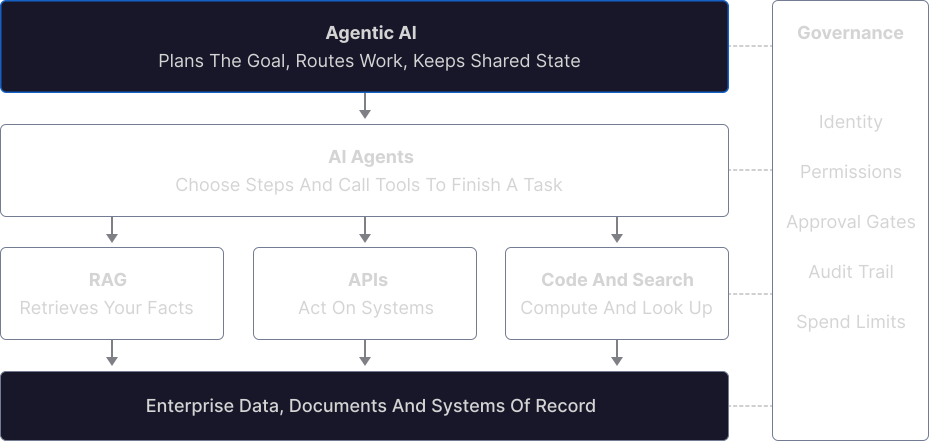
Fig. enterprise AI stack · 4 layers with governance alongside
Read it from the bottom. Enterprise data and APIs are the ground truth. RAG and other tools expose that ground truth safely. AI agents use those tools to complete tasks. The agentic layer decides which agent does what and in which order. Governance applies at every level, not only at the top.
What is agentic RAG and how does it work?
Agentic RAG is retrieval augmented generation with an agent in charge of the retrieval. Instead of one fixed lookup, the agent plans its searches, rewrites weak queries, checks whether the retrieved material answers the question, and searches again or switches source if it does not. It is the first place most teams feel the difference between a pipeline and an agent, and it is often the right next step after a basic RAG system.
Which one do you need?
Use the simplest layer that solves the problem. Work down these questions and stop at the first yes.
- Is the problem “people cannot find or trust the answer”? Build RAG. Policy assistants, product knowledge and support search belong here.
- Can you write the steps down in advance? Build a workflow that calls a model and RAG at fixed points. It is cheaper, faster and easier to audit than an agent.
- Does the path vary case by case, inside one job? Use an AI agent with a small, well-defined set of tools.
- Does the work cross teams, systems or specialisms, with decisions along the way? That is a case for agentic AI, and for the governance budget that goes with it.
Two rules keep this honest. Do not add a layer to hide a fault in the layer below: if retrieval is poor, agents will only act faster on bad information. And measure the result in business terms. Gartner's advice is to pursue agentic AI only where it delivers clear value or ROI.
What does the 2025 to 2026 data say?
Adoption is real, value is uneven, and governance is the gap. These are the figures enterprise IT teams are quoting.
| Finding | Source |
|---|---|
| 40% of enterprise applications will include task-specific AI agents by the end of 2026, up from under 5% in 2025 | Gartner, Aug 2025 |
| Over 40% of agentic AI projects will be cancelled by the end of 2027 because of cost, unclear value or weak risk controls | Gartner, Jun 2025 |
| 40% of organisations with revenue above $1 billion are scaling AI agents in at least one function, up from 27% a year earlier; smaller organisations are flat at 22% | McKinsey, Aug 2026 |
| 37% of respondents attribute any EBIT impact to AI, and about 6% qualify as high performers | McKinsey, Aug 2026 |
| Nearly three-quarters of high performers have redesigned workflows around AI, against about a quarter of everyone else | McKinsey, Aug 2026 |
| AI-co-authored pull requests carry about 1.7 times as many issues as human-only ones | CodeRabbit, Dec 2025 |
| 54% of organisations have no defined approach to limiting AI agent access, or reuse human access rules | Gartner, Sep 2026 |
| By 2028, 25% of enterprise security breaches will trace back to AI agent abuse | Gartner, Oct 2026 |
Three things follow for anyone building with these patterns.
The value comes from redesign, not from the tool. McKinsey's high performers are separated from the rest by reworked workflows, not by access to better models. Dropping agents onto an unchanged process mostly automates its inefficiency.
Speed without structure creates review debt. The CodeRabbit numbers describe what happens when generation outruns standards. The remedy is to constrain what agents can produce, so that fewer defects are possible in the first place.
Agentic AI security is an identity problem. An agent with broad credentials is an insider with no judgment. The OWASP Top 10 for Agentic Applications, published in December 2025 with input from more than 100 practitioners, is a sensible baseline for threat modelling before anything reaches production.
The takeaway
RAG, AI agents and agentic AI are not rungs on a ladder that every team must climb. They are answers to three different questions: what does the system know, what can it do, and who decides what happens next. Plenty of valuable software stops at the first.
If you remember one thing, make it the control-flow test. Wherever your code owns the steps, you get predictability and cheap testing. Wherever a model owns them, you get flexibility and you pay for it in cost, variance and review. The craft is in deciding, step by step, which parts of a system deserve which.
That is the bet behind WaveMaker: let agents handle intent, and let deterministic generators handle the code. If you want to see how that plays out on a real application, try the WaveMaker platform.
Frequently Asked Questions
How does agentic AI compare to generative AI?
Agentic AI differs from generative AI in that agentic AI acts, while generative AI only produces content. Generative AI creates text, code or images in response to a prompt. Agentic AI uses generative models as its reasoning engine and adds planning, tool use, memory and coordination, so it can complete multi-step goals across systems with limited human input.
What is agentic AI and how does it differ from traditional AI?
Agentic AI is a type of AI system in which one or more AI agents plan, decide and act toward a goal with limited human supervision. Traditional AI follows fixed rules or makes narrow predictions, such as scoring a transaction for fraud. Agentic AI chooses its own steps and adapts when results change, within limits that people define.
How does multihop RAG compare to single-hop queries?
Multihop RAG performs several linked retrievals to answer one question, while single-hop RAG performs one. Single-hop RAG suits direct lookups such as “what is our travel policy?” Multihop RAG suits questions that span documents, such as “which suppliers on expiring contracts failed an audit this year?” Multihop RAG is more accurate on those questions but slower and more expensive.
What should I consider when choosing an AI agent platform?
When choosing an AI agent platform, consider six things: integration with existing systems and identity providers, per-agent permissions, human approval and rollback, audit trails, cost controls, and ownership of the output. Agentic AI frameworks offer more flexibility but need more engineering. Managed agentic AI platforms are faster to start with but offer less control.
What features should I look for in an AI coder agent?
The most important features in an AI coder agent are adherence to your architecture and coding standards, whole-repository awareness, test generation, reviewable diffs before commit, rollback, and limits on what the agent may change. A December 2025 CodeRabbit study found AI-co-authored pull requests had about 1.7 times as many issues as human-only ones, so review controls matter.
What are the best AI agent builders on the market?
The best AI agent builder depends on what is being built, and no single product leads every category. Managed cloud builders such as Google's Vertex AI Agent Builder suit teams already on that cloud. Model-vendor kits, including OpenAI agent tooling, suit projects built on one model family. Open-source agentic AI frameworks such as LangGraph and CrewAI suit teams that want full control. Agentic app generation platforms such as WaveMaker suit enterprise application delivery.


