What Features Should You Look for in an AI-Assisted Application Development Tool for Your Enterprise?
The easiest way to judge an AI application development tool is to give it a prompt and see what it builds. In a few minutes, you may have a working screen, a database connection, and enough functionality to make the technology feel transformative. But that first impression tells you very little about how the same application will behave inside a real enterprise development environment.
Enterprise applications rarely start with a blank canvas. They have established architectures, design systems, APIs, identity and access controls, security requirements, source repositories, testing practices, deployment pipelines, and years of existing business logic to work around. An AI tool that generates a convincing application in isolation may still create problems when that application needs to fit into everything else.
That is why evaluating AI application development tools requires a different set of questions. How does the tool interpret requirements? What controls the architecture it generates? Can developers review and change what AI produces? Can the resulting code be tested, versioned, secured, deployed, and maintained using the processes the organization already has in place?
The best AI-assisted development tools are therefore not simply the ones that generate the most code. They are the ones that combine AI-driven productivity with the engineering controls enterprises need to turn generated software into software they can actually own and operate.
This guide breaks down the capabilities that matter when evaluating an AI-assisted application development tool for enterprise use.
What should an enterprise look for in an AI development tool?
An enterprise-grade tool for AI application development should provide more than code generation.
At minimum, look for:
- Architecture and guardrails that keep generated applications consistent.
- Design-system support so AI-generated interfaces follow established UX standards.
- Human control and review rather than completely opaque autonomous generation.
- Code ownership and portability so your team controls the resulting application.
- Enterprise integrations for APIs, authentication, data, and existing systems.
- Security and governance built into the development workflow.
- Source control and CI/CD integration so AI-assisted work fits your existing SDLC.
- Multi-platform support if your organization develops both web and mobile applications.
- Maintainability and upgradeability beyond the first generated release.
- A way to control AI variability so different prompts don't continually produce different application structures.
That last point is becoming particularly important. The first wave of AI development focused heavily on generating code faster. The next stage is about making app development using AI repeatable enough for teams to use at scale.
Why enterprise AI application development is different
A prototype has a short memory. An enterprise application doesn't. A prototype can tolerate shortcuts because its main job is to answer a question: Does this idea work? A production application has a much longer list of responsibilities. It may connect to customer data, expose business processes, enforce permissions, integrate with several internal systems, support thousands of users, and remain in active development for years. That changes the definition of success.
For a prototype, the question might be: How quickly can AI generate something that works? For enterprise AI application development, the better question is: How quickly can AI help us build something that our developers can understand, govern, deploy, and maintain?
This is also where current thinking around AI-driven AppDev is heading. ISG's 2026 research describes enterprise AI-driven application development as an integrated environment spanning requirements, design, source and artifact control, testing, releases, lifecycle governance, collaboration, workflow integration, security, and access controls, not simply a code-generation feature. That distinction should guide your evaluation.
1. Look for architecture, not just AI generation
This should be the first question on your shortlist. What architecture does the tool produce when AI starts building an application?
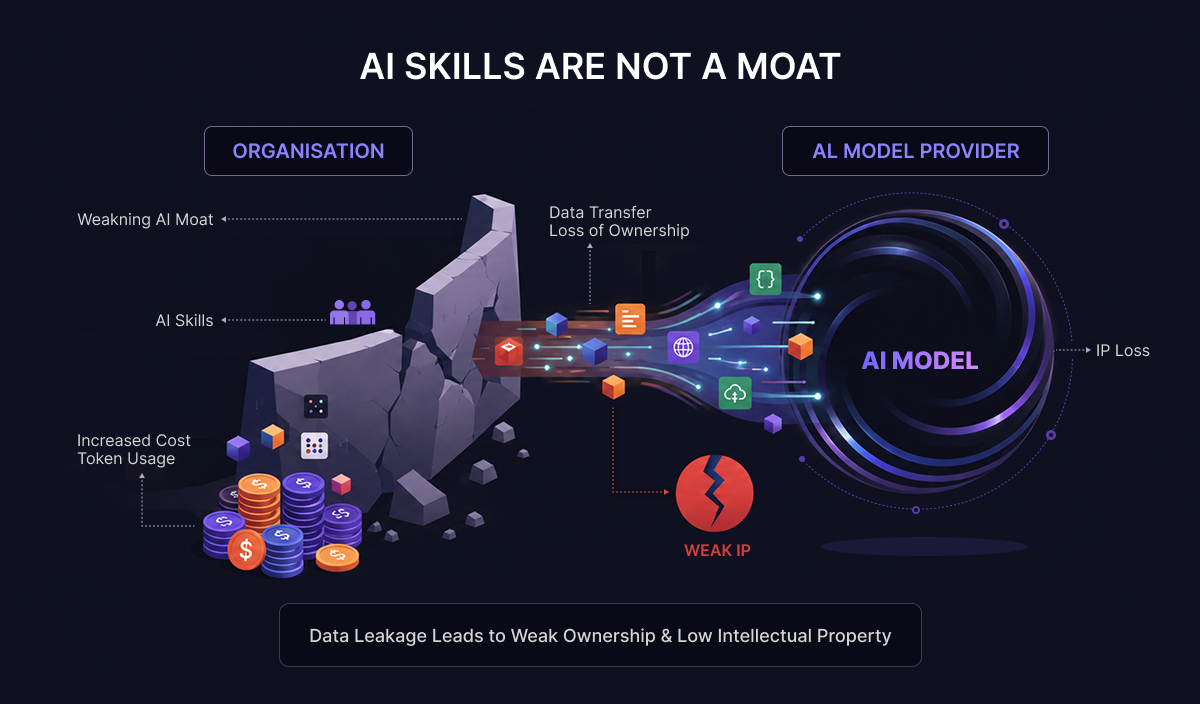
A general-purpose AI model can generate perfectly plausible code. That doesn't necessarily mean it will produce the same architectural patterns consistently across a large application.
One prompt might create a component one way. Another prompt might solve a similar problem differently. A third developer might get another variation.
For a small prototype, that's usually fine. For enterprise ai based app development, it can become technical debt surprisingly quickly. The better approach is to give AI a defined application structure to work within.
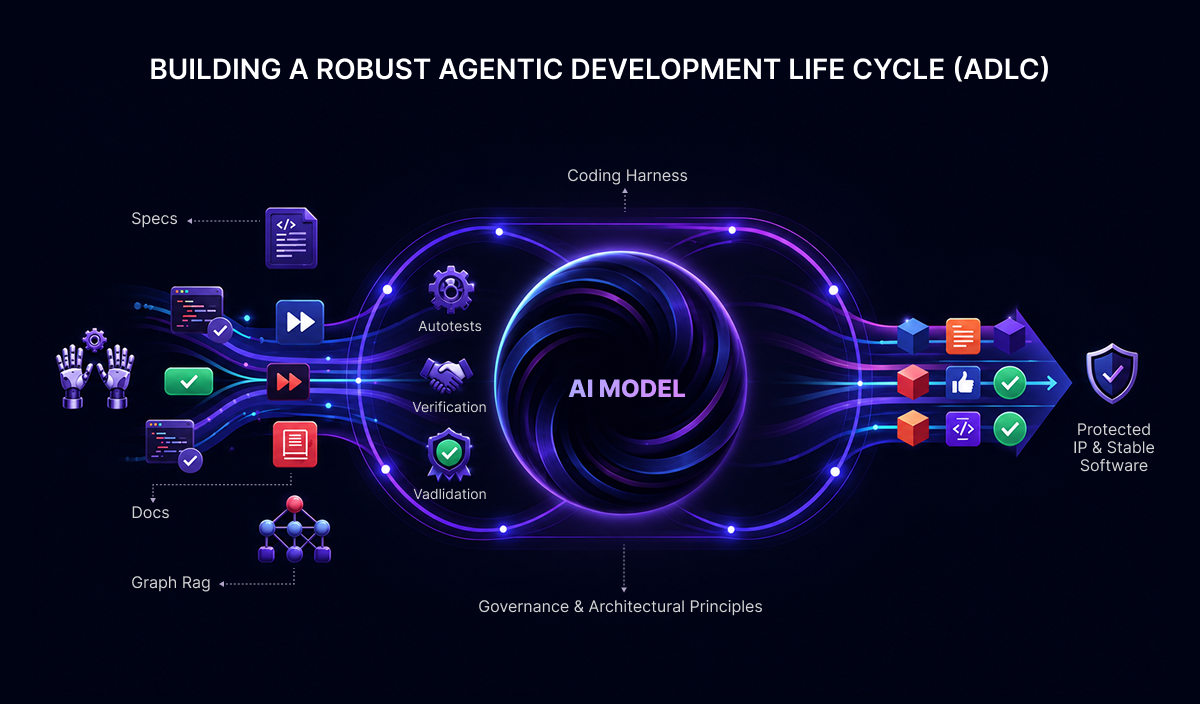
WaveMaker takes this architecture-first approach. Its platform combines open-standard application architecture with enforced components, design tokens, API services, integration variables, and development guardrails.
The underlying idea is that AI should have room to reason, but not unlimited freedom to reinvent the application architecture every time it generates something.
What to test
Don't ask a vendor to show you one generated screen.
- Ask them to generate:
- several related screens;
- shared components;
- API integrations;
- validation logic;
- navigation;
- authentication;
- and a new feature added to an existing application.
Then inspect whether the resulting application still follows the same patterns. That tells you much more about the tool than a polished demo.
2. Look for deterministic or controlled generation
This is closely related to architecture, but it deserves separate attention. Generative AI is probabilistic by nature. The same instruction does not necessarily produce the exact same implementation every time. That flexibility is useful when you're exploring possibilities. It is less attractive when you're maintaining production software.
This is one reason WaveMaker uses a two-pass generation model. AI first translates design or intent into WaveMaker Markup Language (WML), a structured intermediate representation. Developers can work with and refine that representation before the platform's generators produce framework-specific application code.
The first pass is about understanding intent. The second is about producing the application. That separation gives developers a much more useful point of control than a one-shot prompt-to-code process. WaveMaker describes the approach as making generation more controllable, repeatable, and easier to evolve.
Why this matters for enterprise AI application development
Imagine that your organization has 100 application screens. You don't want every new AI request to potentially introduce a new component pattern, a new way of handling state, or a new interpretation of your design system. The more software you build with AI, the more valuable consistency becomes.
3. Design-system awareness should be a core feature
AI can make an application look good. That is not the same as making it look like your application.
Enterprise teams increasingly have established design systems, component libraries, accessibility standards, typography, spacing rules, and brand guidelines. Those shouldn't disappear when AI enters the development workflow.
This is particularly important because enterprise users now expect the same level of usability from workplace applications that they experience in consumer software. WaveMaker believes that the old divide between consumer and enterprise UX is disappearing, with usability and visual quality increasingly affecting adoption and engagement.
So when evaluating an ai assisted development tool, ask:
- Can it consume your existing design system?
- Can it work with Figma?
- Can it understand design tokens?
- Does it use reusable components?
- Can developers modify those components centrally?
- Does a change to the design system propagate consistently?
WaveMaker's design-to-code workflow starts with Figma and converts designs into application artifacts using AI-generated design tokens mapped to WaveMaker UI components. Those artifacts can target Angular and React for web and React Native for mobile.
That makes design a development input rather than a reference image developers have to reproduce manually.
4. Make sure AI can work with your existing APIs and systems
Enterprise applications rarely exist on their own. A customer portal may need CRM data. An employee application may need HR systems. A banking application may connect to authentication services, transaction APIs, analytics, notifications, and several internal systems.
This means an AI tool that only generates attractive frontends isn't enough. For serious AI app development, integration needs to be a first-class capability.
Look for support for:
- REST and other API patterns;
- authentication and SSO;
- API discovery and binding;
- data services;
- reusable integration components;
- event handling;
- backend services;
- security policies;
- and environment-specific configurations.
WaveMaker's AI agents are designed to handle practical application-development tasks such as API integration, UI validation, event handling, microservice creation, security configuration, navigation, state management, and language support.
That is a more useful definition of AI-assisted development than simply asking an LLM to write a function.
5. Keep developers in the loop
There is a temptation to think that the best generative AI app development platform is the one that requires the fewest human decisions.
For enterprise software, it's usually the opposite. The important question isn't: How much of the developer can the AI replace? It's: How much repetitive work can AI remove while leaving the developer in control of important decisions?
Enterprise applications involve tradeoffs that cannot always be inferred from a prompt. Developers still need to judge architecture, performance, security, data handling, user experience, and business requirements.
WaveMaker's workflow reflects this human-in-the-loop model. Developers can move between prompt-based interaction, a visual workspace, and direct code editing, using WaveMaker Studio to validate and refine what AI produces.
That is particularly useful for teams adopting app development using AI gradually. They don't have to choose between completely manual development and full automation. They can decide where AI adds value and where human review remains necessary.
6. Code ownership matters more than generation speed
This is one of the questions buyers often leave until too late. Ask: What happens to the code when the application is finished?
Can your developers:
- check it into Git?
- modify it?
- review it?
- test it?
- deploy it?
- extend it?
- move it between environments?
- continue working on it without the AI platform?
If the answer is unclear, investigate further.
WaveMaker uses industry-standard code templates to generate web and mobile application code that developers can extend, embed, or export. The generated code is owned by the customer team and can be checked into systems such as GitHub, GitLab, or Bitbucket.
That's important because the AI tool should accelerate the creation of the application without becoming the only place where the application exists. Your application should remain your engineering asset.
7. Security and governance cannot be an afterthought
This is where enterprise ai based app development diverges sharply from casual experimentation. The application may contain sensitive data. It may need authentication and authorization. It may have regulatory requirements. It may need audit trails and controlled deployment.
And AI-generated code introduces another question: how do you know what the AI has produced is acceptable?
Recent enterprise AI guidance increasingly treats governance as something that needs to be embedded in operational workflows rather than handled through policy documents alone. The same principle applies to AI-assisted software development.
Look for:
- authentication and SSO support;
- role-based access;
- security configuration;
- controlled environments;
- source control;
- auditability;
- testing;
- approval workflows;
- secure deployment;
- and clear ownership of generated artifacts.
WaveMaker's platform includes AI-assisted security configuration, including authentication and SSO, while its broader development model keeps applications within established SDLC processes.
8. It should fit your existing SDLC
AI shouldn't create a parallel software development universe. Your organization already has processes for:
Plan → Design → Develop → Test → Review → Deploy → Maintain
The AI development tool should fit into that process.
This is another area where current AI-driven AppDev research is useful. ISG specifically identifies source and artifact version control, testing, release planning, lifecycle governance, collaboration, workflow automation, integration, and security as important parts of an enterprise AppDev platform.
When evaluating a tool, ask:
- Can this work with our existing Git workflow?
- Can developers review the generated output?
- Can it work with our CI/CD pipeline?
- Can it support our deployment environments?
- Can security and QA teams use their existing controls?
WaveMaker Studio is designed as an integrated development environment rather than a chat layer attached to a separate coding workflow.
It allows integrations with source-control systems, artifact repositories, API and component marketplaces, and deployment infrastructure including AWS, Azure, Kubernetes, and on-premise environments. That matters when moving from experimentation to production.
9. Check whether it supports web and mobile development
Not every organization needs mobile applications. But if yours does, don't assume that a tool that generates a web application can automatically give you a good mobile experience.
AI mobile app development introduces its own considerations around:
- responsive layouts;
- native capabilities;
- device APIs;
- performance;
- navigation;
- authentication;
- offline behavior;
- and platform-specific UX.
WaveMaker supports Angular and React for web and React Native for mobile. Its React Native Studio with reusable UI components provide support for network-connected mobile capabilities.
For teams building network-aware mobile applications, WaveXD (a unit of WaveMaker) extends WaveMaker’s mobile app development capabilities with ready-to-use, customizable components pre-wired to 5G Network APIs, helping developers add capabilities such as fraud prevention, asset tracking, identity verification, and on-demand quality-of-service without building those integrations from scratch.
For teams building multiple application types, having these capabilities within a common development model can reduce fragmentation.
10. Look for reusable components, not just reusable prompts
Prompt libraries are useful. Reusable application components are better. If every developer has to explain the same rules to an AI model repeatedly, you're relying on prompts to enforce standards that should probably exist in the development system itself. A mature AI assisted development tool should give teams reusable building blocks.
That could include:
- UI components;
- design tokens;
- API services;
- application templates;
- architectural patterns;
- security configurations;
- integration variables;
- and domain-specific agents.
WaveMaker's architecture includes enforced components and design tokens, a customizable component repository, API services, and the ability to create domain-specific agents. This changes the economics of team-scale development.
Instead of every developer reinventing the same solution with AI, the organization can establish a reusable pattern once and let AI work within it.
11. Custom agents can be valuable, but only when they're grounded
The word “agent” is everywhere in enterprise AI right now. But adding an agent doesn't automatically make a development platform better. The useful question is: What can the agent actually do inside the application lifecycle?
WaveMaker's agent framework is designed around concrete development tasks rather than generic conversation. Its agents can assist with frontend development, API creation and integration, UI validation and event handling, enterprise microservices, security and SSO, internationalization, navigation, and state management.
The platform also allows organizations to build domain-specific agents around their own use cases and standards. For enterprise generative AI app development, that is a more useful model than simply giving developers a chatbot and asking them to figure out the workflow themselves.
12. Don't overlook maintainability and upgrades
The most revealing question you can ask an AI development platform isn't: “How fast can you build an application?” Ask: “What happens when the application changes?”
Because it will. APIs change. Design systems change. Security requirements change. Frameworks change. Business processes change. Developers leave and new ones join. An enterprise application needs to survive all of that.
WaveMaker's approach separates the structured application representation from framework-specific code generation. It uses industry-standard code templates, automatic stack upgrades, and compatibility support. That is an important consideration for long-lived AI application development.
13. Evaluate AI cost and efficiency, not just developer productivity
There's another consideration that doesn't get enough attention in discussions about AI development tools: LLM consumption.
If every small change requires an AI model to regenerate large amounts of application code, costs and latency can grow quickly. A structured intermediate representation can help here too.
WaveMaker's two-pass model allows developers to iterate primarily at the WML level rather than regenerating large quantities of framework-specific code for every change. Its platform positioning also emphasizes minimizing unnecessary LLM spend.
For an enterprise running AI-assisted development across many developers, these details can add up.
The right question is not simply: “How much does the platform cost?” It is: “What does it cost to operate this development model at team scale?”
14. Test the tool against a real enterprise application
This may be the most important recommendation in the entire article. Don't evaluate an AI development tool using the vendor's sample application. Bring your own. Choose something that contains the messy parts of your environment:
- a complicated screen;
- an existing API;
- authentication;
- reusable components;
- a real design;
- business rules;
- validation;
- several related workflows.
Then ask the vendor to help you build it. Watch what happens.
Does the AI understand the design?
Does it respect your components?
Does the architecture remain coherent?
Can developers modify the output?
Can the application connect to your APIs?
Can security controls be applied?
Can the result enter your normal Git and CI/CD process?
What happens when you change the requirements?
That exercise will tell you more than a dozen feature tables.
AI application development should make enterprise teams faster, not less disciplined
There is a lot of excitement around AI because it removes friction from software development. That's a good thing.
Developers shouldn't have to spend hours writing repetitive UI code, wiring predictable integrations, or recreating the same application patterns. But removing friction isn't the same as removing engineering.
The strongest AI application development tools will be the ones that combine the two.
They will let AI handle more of the repetitive work while giving teams stronger control over architecture, design, security, integrations, testing, deployment, and long-term maintenance.
That is particularly important as ai enterprise applications become more common. The cost of an inconsistent prototype is small. The cost of an inconsistent system that runs a critical business process is not.
So when you're comparing AI assisted development tools, don't ask which one can generate the most code. Ask which one can help your team generate the right software, within the right architecture, with the right controls, and keep it maintainable after the AI has finished its first pass. That's the standard enterprise ai app development should be held to.
Frequently Asked Questions
What are the benefits of using AI in application development?
The biggest benefit is that AI can take repetitive development work off a developer's plate. It can help generate interfaces, connect APIs, create application logic, write validation, explain code, and speed up iteration.
The more interesting benefit for enterprises is consistency and reuse. When AI works within established architecture, components, design systems, and development standards, teams can use automation without creating a collection of unrelated applications. WaveMaker's approach combines AI agents with architecture, design tokens, reusable components, and a two-pass generation process for this reason.
What are the key features of generative AI application development?
The useful features go beyond prompt-to-code generation. For enterprise teams, look for support for application architecture, design systems, API integration, security, reusable components, human review, source control, testing, deployment, and maintainability.
Generative AI is most useful when it is connected to the rest of the development lifecycle. WaveMaker, for example, combines AI agents with structured application markup, design-to-code, visual development, code generation, and SDLC integrations rather than treating generation as a standalone activity.
How can AI-powered web application development improve user experience?
AI can speed up the journey from a design or requirement to a working interface, but good UX still depends on design decisions and consistency.
For enterprise applications, the useful capability is therefore not simply “AI can make a screen.” It's the ability to carry an organization's design system—components, tokens, layouts, and visual rules—into the implementation.
WaveMaker's design-to-code workflow starts from Figma and maps design tokens and components into its application component system, helping teams create consistent web experiences rather than treating every generated page as an isolated design.
What are the advantages of generative AI in application development?
Generative AI can shorten development cycles, reduce repetitive coding, help developers explore solutions faster, and make application changes easier to initiate.
For enterprise teams, though, the biggest advantage comes when generation is paired with structure. A tool that understands the application's architecture and design system can reduce the amount of context developers have to repeatedly provide and make AI-assisted work more consistent across a team.
That's why WaveMaker combines generative capabilities with a structured intermediate representation, reusable components, design tokens, enterprise architecture, and human validation.
What is the best AI for application development available today?
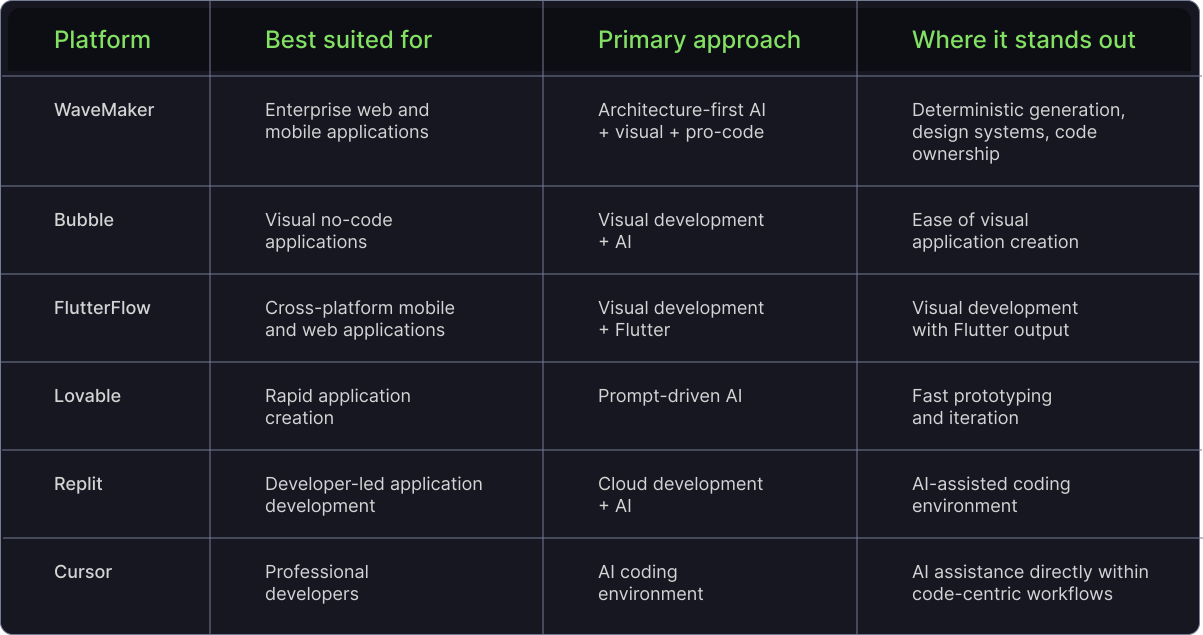
There isn't one AI model or tool that is best for every application. The right choice depends on whether you're building a prototype, accelerating individual developers, or delivering long-lived enterprise software.
For enterprise AI application development, evaluate the complete development system rather than the underlying model alone. Architecture, design systems, security, integrations, code ownership, SDLC support, maintainability, and governance can have a greater impact on the success of the application than which model generated a particular piece of code.
WaveMaker's approach is designed around that broader problem: combining AI agents with architecture-first generation, design-to-code, human review, standard application code, and enterprise development workflows.