


AI differs from previous technology waves because it increasingly performs the implementation work that historically created demand for IT services. Drawing on 35 years of experience across ERP, SaaS, cloud, and AI, Vijay Pullur argues that the future belongs to organizations that transform domain expertise into proprietary software products rather than relying solely on labor-based services.
The rapid rise of large language model platforms – Anthropic, OpenAI, Google Gemini – has put the global IT services model in serious jeopardy of becoming obsolete. Dramatic as that sounds, I believe it is precisely the right framing.
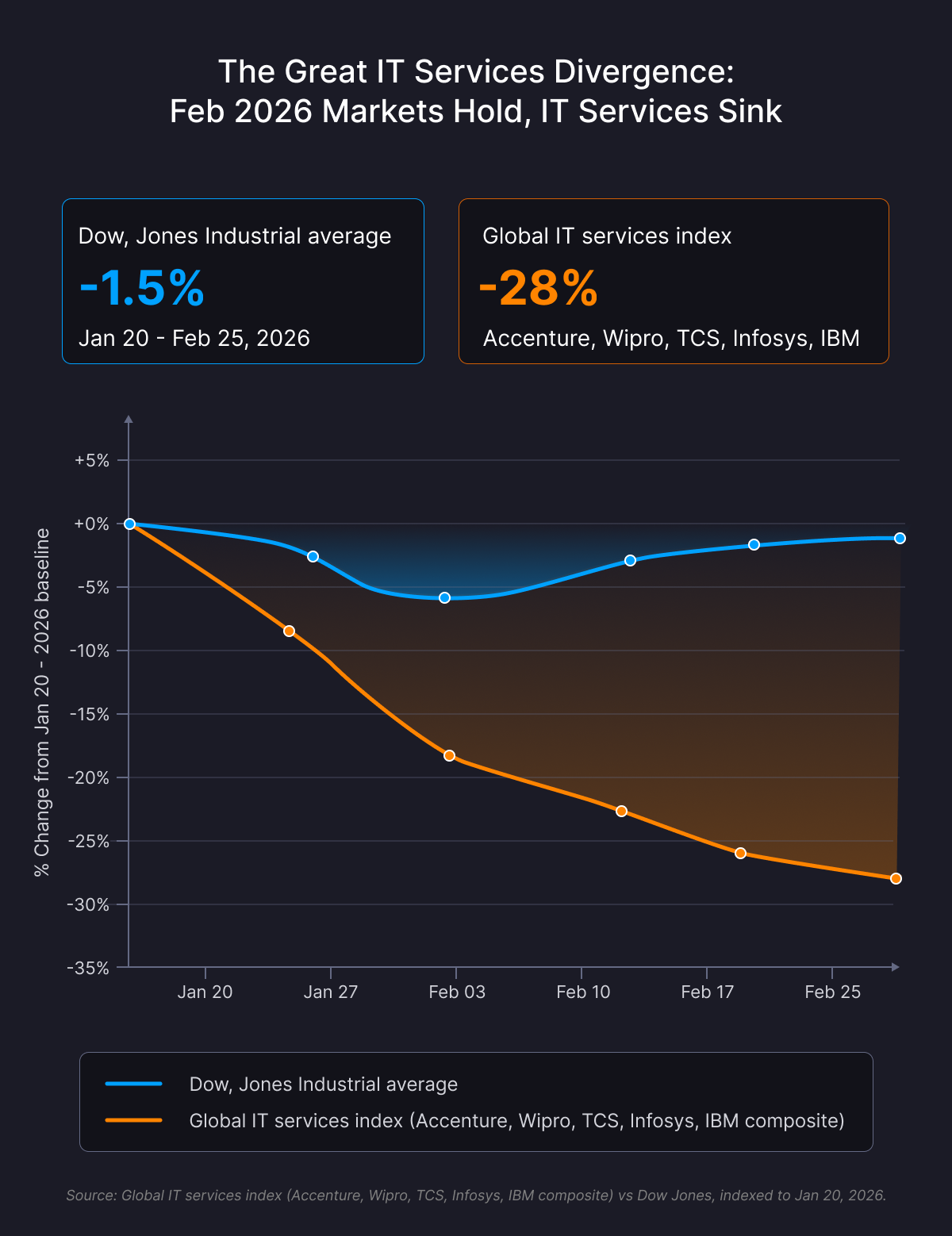
Since January 20th, shares of virtually every major global IT services company have dropped between 20 and 30 percent. Accenture is down roughly 30 percent. IBM is down 24% with a single-day 13% decline around February 23rd-24th. Wipro and Coforge have shed nearly 25 percent. TCS, Infosys and HCL Tech are all trading at multi-year Lows.
The only comparable sector decline in such a compressed window was COVID-era 2020 – except that time, the Dow Jones fell 39 percent alongside them. This time, the Dow is essentially flat.
The broader economy is not in crisis. It’s the IT services business model that the market is repricing – and it is signaling a seismic shift.
| Previous Platform Shifts | AI |
| Needed implementation partners | Performs implementation |
| Expanded services demand | Compresses some services demand |
| Separate product and service | Increasingly combines them |
| More consultants required | More automation possible |
Mounting the Horse: A 35-Year Playbook
AI impacting traditional revenue models built around human capital seems to be the central story for this collapse. However, nearly every major IT services firm has announced an AI partnership. Accenture joined OpenAI’s Frontier Alliance alongside McKinsey, BCG, and Capgemini. TCS, Infosys, and Wipro all have deals with Anthropic, OpenAI, or Google.
In previous cycles, announcements like these would lift a company’s stock for weeks. This time, Accenture’s shares fell 6.6 percent on the very day it announced its OpenAI partnership. The market is not buying the story.
The 35-year IT services playbook used to be: announce a partnership with the rising platform, stand up a competency center, train people, and use the partner’s brand to win enterprise contracts. SAP and Oracle in the ’90s for ERP implementation. Salesforce in the 2000s for SaaS-led services. AWS, Azure, and Google Cloud in the 2010s for Cloud migration. Each time, the software platforms made clear that services were not their business. They left the gap open. Services firms filled it and built empires. I call this “mount the horse and ride.” We did exactly this at Imaginea – the technology services company I co-founded under Pramati, later acquired by Accenture. Pick the fastest horse early enough, and you win.
Not anymore.
AI Is Different. You’re Riding a Tiger.
What is an AI platform shift?
Unlike cloud computing or SaaS, AI platforms increasingly automate portions of the software development and implementation process itself, changing the economics of IT services rather than simply introducing another technology stack.
In every previous cycle, technology vendors needed IT services companies. But AI does not need implementers in the same way – it is the product and service – rolled into one. When Claude Code can automate COBOL modernization, and when the CEOs of Anthropic and OpenAI publicly state that software engineering roles will largely disappear within three years, they are not describing disruption. They are describing replacement. On a horse, you are in control. The tiger turns on you eventually.
Jefferies just downgraded TCS, Infosys, HCL Technologies, and three other major IT firms, explicitly citing AI as a structural threat to the business mix. JP Morgan warned that clients will reallocate spending as AI-led efficiencies shrink demand for managed services. This is now the mainstream analytical consensus – not a fringe view.
Build the Moat or Become Irrelevant
The answer is not another partnership announcement. The era of scaling revenue by scaling headcount is over. The firms that survive will use their deep domain expertise— the genuine understanding of how enterprises actually work—to build proprietary software assets. Proprietary software assets are reusable software products, platforms, frameworks, or intellectual property that generate value independently of billable engineering hours. Products that clients cannot simply replace with a prompt. Use AI to build at extraordinary velocity but build something that is yours. The most pragmatic path may be acquisition: seed a product culture with companies that already have it and play the game with your software; not just your services.
This blog is originally published on Business Today.
FAQs
Q1. What does "mount the horse" mean in tech services history?
"Mount the horse" describes the strategy that helped IT services companies grow through previous technology waves. When platforms such as SAP, Oracle, Salesforce, AWS, Azure, or Google Cloud emerged, services firms built expertise around them, trained engineers, became implementation partners, and helped enterprises adopt those technologies. This approach proved highly successful for decades because platform vendors relied on services firms to drive adoption.
Q2. What is the "riding a tiger" analogy for AI in business?
The "riding a tiger" analogy illustrates why AI differs from previous technology platforms. Earlier platforms depended on IT services companies for implementation, allowing both platform vendors and services firms to grow together. AI, however, increasingly performs some of the implementation work itself. In that sense, AI is not simply another platform to ride - it is a force that can fundamentally reshape or even replace parts of the traditional services business model, requiring companies to rethink how they create long-term value.
Q3. How is generative AI replacing traditional IT implementers?
Generative AI is automating many software development tasks that previously required large implementation teams, including code generation, application modernization, documentation, and testing. While human expertise remains essential for enterprise architecture, governance, and business strategy, AI is reducing the amount of manual implementation work that has historically driven revenue for IT services firms.


