The Innovation Puzzle 2.0: Connecting Enterprise AI Platforms to Business Value

The tech landscape constantly evolves, making it tempting to chase every new trend. Ironically, in today’s business world, the word “innovation” has become almost synonymous with technology adoption. Yet after years of leading digital transformations, I’ve learned that sustainable innovation isn’t about having the latest technology, it’s about solving business problems and delivering measurable impact.

In 2025, the hype was “we’re building an AI strategy.” In 2026, it’s becoming clearer that many of those strategies were more aspirational than actionable - some even serving more as positioning than practical guidance. The latest wave of generative AI has carried a magic-wand promise: that simply generating outputs would unlock transformation overnight.

But enterprises are quickly realizing that generating output was never the hard part. The real challenge, and the real differentiator is governing it responsibly, securing it end-to-end, controlling its behavior, making it cost-effective, and scaling it sustainably across the enterprise.

This is where enterprise AI platforms and generative AI platforms need to evolve beyond generation alone. Organizations need platforms and architectures that connect AI capabilities to existing applications, data, APIs, development workflows, security controls, governance and measurable business outcomes.

The question is no longer simply whether an organization should adopt AI. It is whether its foundation is ready to turn AI capabilities into sustainable innovation.


Building a Foundation for Enterprise AI Platforms and Application Modernization

When executives talk to me about building innovation capabilities, conversations often jump straight to technology investments. While modern tools and platforms play a role, successful organizations understand that innovation is built on a broader foundation. It requires a deliberate balance between modernizing systems, improving experiences, and empowering people.

This holistic approach helps organizations avoid the common trap of implementing technology without purpose.

A 2026 enterprise AI adoption study reinforces that the real gap in innovation isn’t experimentation - it’s underestimating foundational readiness across data, architecture, and operating models.

For organizations evaluating enterprise AI platforms, this foundation matters. AI capabilities cannot deliver sustainable value if the systems, data, application architecture and operating processes underneath them remain fragmented.


Core Modernization: The Technical Base

Most transformation initiatives fail not from choosing the wrong technology, but from not first asking what problem needs solving. The goal isn’t to eliminate all legacy systems - it’s to identify which modernization efforts will drive meaningful business outcomes.

One large financial services organization learned this during its AI-driven transformation: before scaling personalized AI recommendations, it first modernized fragmented backend data spread across legacy systems, enabling faster onboarding and improved customer servicing.

Success in modernization requires focus in two key areas.


1. System Transformation: Modernizing Legacy Applications

Great enterprise technology is never just about what’s under the hood. Apple proved this; its edge was never the most features, but making powerful technology feel effortless.

The same holds for enterprise modernization: architecture without adoption is just expensive infrastructure. Enterprises that get this right think in three layers from day one:


Architecture-first

Define how systems connect, where data lives, where AI fits, and how governance is enforced. Every modernization decision that follows should align to this blueprint. Without it, teams modernize in isolation and recreate the fragmentation they were trying to solve.

This is particularly important for legacy application modernization. Modernization does not always mean replacing every existing system. It can involve strategically modernizing the parts of an application architecture that are creating friction while preserving valuable business capabilities.

The right application modernization software and architecture can help organizations evolve legacy applications while creating a foundation for new digital experiences and AI-powered capabilities.


API development as the connective tissue

APIs are the boundaries between capabilities, not just integration points. Design them to be governed, versioned, secured, and observable.

An API layer allows enterprises to expose capabilities from existing systems through well-defined interfaces. This creates a separation between backend systems and the experiences built on top of them.

For organizations undertaking legacy app modernization, this can be particularly valuable. Existing systems can continue supporting core business processes while new applications, experiences and AI capabilities consume their functionality through governed APIs.

A mature API development platform can therefore become an important part of an application modernization strategy, helping teams create reusable services rather than repeatedly rebuilding the same functionality.


Experience Layer: Bridging UX and Business Workflows

A large retail bank improved its digital experience by first building an Experience API layer to unify fragmented backend systems into consistent, real-time customer journeys. This reduced delays in key user flows, significantly improving UX. Mobile app ratings, customer satisfaction scores, and self-service adoption all increased as a result.

The key shift wasn’t AI, it was fixing the experience foundation first through APIs. The experience layer delivers when it gets two things right:

Adaptive interfaces: Personalization and self-service at scale, across roles, contexts, and form factors.

Design elegance: Users accomplish tasks without friction; voluntary adoption is the proof.

Architecture gives you the blueprint. APIs give you the boundaries. The Experience Layer gives you adoption.

This foundation also becomes increasingly important as organizations introduce generative AI applications. AI-powered experiences still depend on the enterprise data, services and APIs underneath them. Without a reliable application architecture, AI simply adds another layer of complexity.


2. Developer Acceleration: From Generative AI Tools to Generative AI Platforms

AI-assisted development tools have fundamentally changed what “fast” means. With tools such as GitHub Copilot and others, generating code is no longer the bottleneck. Knowing whether that code is correct, secure, scalable, and architecturally sound is.

The risk enterprises face today isn’t moving slowly; it’s accelerating without the controls to ensure what’s being built is the right thing, built the right way. This is where generative AI platforms need to move beyond raw code generation.

For individual developers, a generative AI tool can dramatically accelerate coding tasks. At enterprise scale, however, organizations need enterprise AI platforms that connect AI-assisted development to architecture, governance, security, design systems and established software delivery processes.

Real development acceleration means teams can build quickly and confidently. That requires:


Composable platforms with architectural guardrails

Assemble capabilities from governed, reusable building blocks validated against your target architecture, security policies, and compliance requirements.

This becomes especially important when teams use generative AI applications across different business units. Shared architectural patterns and reusable components help ensure that every application does not become its own isolated implementation.


CI/CD as a quality and governance gate

Automated CI/CD pipelines enforce code quality, security scanning, dependency checks, and architectural compliance at every commit. This is where accountability lives.

For organizations adopting generative AI, integrating AI-assisted development into an existing CI/CD pipeline helps ensure that increased development speed does not bypass established engineering controls.

A disciplined CI/CD deployment process can provide automated checks before applications move into production.


Reusable components with clear ownership

Components are built with ownership: maintained, versioned, performant, scalable, and accountable.

Reusable components also create a common foundation for generative AI platforms. Instead of allowing AI to generate every element from scratch, organizations can constrain generation around approved components, patterns and architectural standards.


Sustainability and maintainability as non-negotiables

Code must remain consistent, modular, upgradeable, and operable at enterprise scale. As AI increases the volume of generated software, the bar for what gets merged must go up—not down.

The mindset shift is simple: AI tools make developers dramatically more productive. The enterprise challenge is ensuring that productivity compounds. What’s built today must be an asset tomorrow, not a burden.

That is ultimately the distinction between using generative AI as an individual productivity tool and adopting enterprise AI platforms as part of a sustainable development strategy.


Connecting Enterprise AI Platforms to Modern Application Architecture

AI does not operate in isolation. The value of enterprise AI platforms depends on how effectively they connect AI capabilities to enterprise data, APIs, business services, applications, security controls and user experiences.

This becomes even more important as organizations move from experimentation toward production-ready generative AI applications.

A modern application architecture can provide the boundaries within which AI operates. APIs can expose governed business capabilities. Security and identity controls can define access. Design systems can establish experience standards. CI/CD processes can enforce quality and compliance.

For organizations exploring AI application architectures, the objective is therefore not simply to insert an AI model into an existing application.

It is to determine:

  1. What data can AI access?
  2. Which APIs can it call?
  3. What actions can it perform?
  4. Which decisions require human oversight?
  5. How is AI behavior monitored?
  6. How are security and compliance enforced?
  7. How does the application remain maintainable as AI capabilities evolve?

For generative AI platforms, these architectural questions are becoming as important as model capability itself.

The same principle applies to agentic AI app architecture. As AI systems move from generating responses to taking actions, the architecture must define the boundaries within which agents can operate.


The ROI of Modern Innovation

Innovation becomes meaningful only when it translates into measurable operational efficiency, stronger customer engagement, and tangible business outcomes.

The ROI of enterprise AI platforms should therefore not be measured by how much AI-generated output an organization produces. It should be measured by what changes for the business.


1. Operational Metrics

AI workflow efficiency
Reduction in human effort per process, measured by time and cost at scale.

Time-to-market acceleration
From idea to production: how much faster teams deliver validated, production-ready capabilities compared to baseline.

Infrastructure and operational cost optimization
Cloud spend, API consumption, and AI inference costs managed against delivered business value. The objective is to scale output without scaling cost proportionally.

This is particularly relevant for generative AI platforms, where model usage and inference costs can increase as applications and workloads scale.


2. User Impact

End-user adoption
Better UX and personalized experiences drive higher engagement, satisfaction, and voluntary adoption.

Team productivity gains
Teams delivering more, faster, with fewer dependencies and handoffs.

Self-service success rate
Users independently completing tasks and workflows through the platform without needing support or intervention.

For generative AI applications, this means measuring whether AI actually reduces friction rather than simply adding another interaction layer.


3. Business Outcomes

Revenue impact
New capabilities, faster product delivery, and personalized experiences directly enabling new revenue streams or expanding existing ones.

Customer satisfaction and retention
Experience quality and self-service capability translating into measurable NPS gains, reduced churn, and stronger customer relationships.

Operational agility
The ability to respond to market changes, launch new capabilities, and adapt to customer needs faster than competitors - the compounding business advantage of a modern foundation.


The AMVC Framework: Bridging Enterprise AI Platforms and Business Impact

Innovation initiatives often stall not from lack of vision or technology, but from the disconnect between AI implementation and measurable business value.

Across industries, organizations have successfully launched AI pilots yet struggled to operationalize them securely, responsibly, and at enterprise scale.

After seeing this pattern repeatedly, I advocate a simple but powerful framework - AMVC: Align, Measure, Validate, and Communicate - to bridge the gap between innovation intent and sustainable business impact.

It ensures investments in enterprise AI platforms and generative AI platforms remain outcome-driven, governable, and adaptable as business needs evolve.


Align
Connect AI initiatives to clear business priorities, define governance boundaries and human oversight requirements upfront, establish operational readiness, and secure stakeholder ownership.

Alignment also means ensuring that generative AI platforms are being applied to problems where AI can create meaningful business value rather than simply because the technology is available.


Measure
Track not just technical performance, but adoption, operational efficiency, customer impact, and business outcomes.

Define clear success criteria that include security and compliance adherence. Track unknowns and emerging risks - how an organization identifies, accepts, and systematically eliminates them is a measure of institutional maturity.

For enterprise AI platforms, measurement should include both AI-specific metrics and broader business outcomes.


Validate
Continuously test with end users, monitor AI behavior against defined boundaries, and validate that outputs are reliable, consistent, and trustworthy at scale - not just in the controlled conditions of a pilot.

This is especially important for generative AI applications, where behavior can vary depending on context, data and interaction.

Validation should therefore extend beyond whether an AI-generated output appears correct. Organizations need to assess whether it remains reliable within the application's architecture, security model and operational environment.


Communicate
Share progress, lessons learned, and measurable outcomes across the organization. Be transparent about what the AI cannot do and where human judgment remains in control.

Momentum requires trust, and trust requires transparency about boundaries as much as capabilities.


Building an Innovation Culture That Scales

Technology and frameworks may create the conditions for innovation, but culture determines whether transformation truly succeeds.

The most advanced architectures, enterprise AI platforms, and AI capabilities will fail to deliver value if people don’t trust them, understand them, or feel empowered to question and improve them.

Building a scalable innovation culture requires focus in three areas.


Enable True Collaboration
Innovation cannot live within technology teams alone. Sustainable transformation happens when business, operations, product, risk, and technology teams work through continuous feedback loops. The best organizations make collaboration part of the operating model, not an exception.

This becomes particularly important when deploying generative AI applications because successful AI adoption often crosses traditional organizational boundaries.


Build Capability Through Practice
AI lowers the barrier to building, but raises the bar for judgment. Organizations must invest not only in tools, but in helping teams critically evaluate AI outputs, understand trade-offs, and innovate responsibly.

Empower citizen developers with the right guardrails, encourage rapid experimentation, and treat lessons from failure as institutional knowledge.

The objective is not to make everyone an AI expert. It is to create an organization capable of using generative AI platforms responsibly within clearly understood boundaries.


Take Calculated Risks Responsibly
In 2026, innovation requires balancing speed with discipline.

Mature organizations know when to experiment aggressively and when to pause until governance, security, or operational readiness catches up. Leaders who model both create a culture that can innovate confidently and sustainably at scale.


The Path Forward

AI is evolving faster than any single framework, governance model, or technology investment can fully anticipate. That’s not a reason to wait. It’s a reason to build with intention.

The organizations that will lead the next wave of innovation are not necessarily those with the most advanced AI, but those that invested early in the right foundations - architecture, governance, scalability, and experience design - before speed made shortcuts tempting.

They built cultures where capability and accountability grew together, and they measured what truly mattered to the business, not just what was impressive to demo.

The innovation puzzle was never just about technology. It has always been about discipline - the discipline to align every investment to a business outcome, validate before scaling, communicate with transparency, and build systems your organization can trust, operate, and evolve.

The pieces are already on the table. The question is whether the foundation exists to bring them together. The future belongs not to those who chase every trend, but to those who build sustainable innovation capabilities that deliver lasting value.


This whitepaper was originally published on DevOps.com


Frequently Asked Questions

What are enterprise AI platforms?
Enterprise AI platforms are platforms designed to help organizations build, integrate, govern, and scale AI-powered applications within existing enterprise environments. Unlike standalone AI tools, enterprise AI platforms need to address architecture, security, governance, integration, development workflows, scalability, and measurable business outcomes.

What are generative AI platforms?
Generative AI platforms provide capabilities for using generative AI to create and develop applications, content, workflows, or other business outputs at scale. For enterprise adoption, generative AI platforms need to go beyond generating outputs and provide the controls, architecture, governance, integration, and validation required for production use.

How do enterprise AI platforms create business value?
Enterprise AI platforms create business value by connecting AI capabilities to measurable improvements in productivity, operational efficiency, customer experience, time to market, revenue, and organizational agility. Their value should be measured by business outcomes rather than AI-generated output alone.

What role does application modernization play in enterprise AI?
Application modernization provides the technical foundation required to integrate AI into existing enterprise environments. Modernizing legacy applications, APIs, data flows, user experiences, and application architectures can make it easier to introduce AI capabilities without disrupting critical business systems.

How should organizations evaluate generative AI platforms?
Organizations should evaluate generative AI platforms based on more than their ability to generate code or content. Key considerations include architectural alignment, security, governance, integration with existing systems, API support, scalability, cost predictability, CI/CD integration, maintainability, and the ability to produce consistent outcomes across teams.
From Demo to Production: Why Agentic AI Systems Fail - and How to Fix Them

Agentic AI systems can look impressive in a controlled demo. A prompt goes in, the system reasons through the request, calls the right tools, and produces an answer or completes a task. But moving from that controlled environment to production introduces a very different set of challenges.

At QCon AI Boston 2026, Venugopal Jigidam our Director of Engineering, shared lessons from his experience building and scaling WaveMaker's Agentic Application Generation Platform. He explores how the platform evolved from an early pilot into a production system with multiple agents, more than 200 tools, and thousands of instructions supporting enterprise application development. WaveMaker's platform itself is designed around an architecture-first approach, with agents, enterprise guardrails, design systems, and a two-pass generation model.

His talk explores a central question facing teams building agentic AI systems today: Why do systems that work so well in demos often struggle when they reach production?

The answer, he argues, is not necessarily a problem with the underlying model. It is often a systems, architecture, and control problem.


Why Agentic AI Systems Work in Demos but Break in Production

A pilot typically operates within carefully controlled boundaries. There is limited context, a small number of tools, a narrow task, and relatively predictable inputs.

Production removes many of those artificial constraints. As agentic AI systems scale, they encounter larger knowledge bases, more tools, more complex workflows, application-specific context, and unexpected edge cases. During the talk, Venu walks through five challenges that emerged as the WaveMaker platform moved from experimentation toward production.

1. Context Overload Leaves Less Room for Reasoning

An LLM receives much more than the user's request. Its context can include system instructions, application information, chat history, documentation, workflows, metadata, and tool definitions.

As these inputs accumulate, the context becomes bloated. The model has to spend more effort filtering irrelevant information, leaving less room for reasoning. This can increase hallucinations, inconsistency, latency, and token costs.

The solution explored in the talk is progressive disclosure: give the model information when it needs it rather than loading everything upfront.

Skills make this possible by allowing agentic AI systems to expose capabilities on demand. Instead of sending every security instruction to an agent when the user only needs OAuth, the relevant skill can be loaded when required.

2. Tool Explosion Makes Agentic AI Systems Harder to Scale

Enterprise agentic AI systems can require hundreds of tools to interact with databases, APIs, security systems, repositories, and other enterprise services. But every tool definition consumes context.

Venu describes how WaveMaker's platform grew to more than 200 tools and encountered the resulting impact on context size and performance. The answer was not to remove capabilities, but to make tool access more selective through tool search.

Instead of loading every available tool, the system can retrieve the tools relevant to the task and expose only those to the model.

3. Agent Orchestration Can Create Information Loss

The next challenge emerged from agent orchestration. The initial architecture used different agents for different product capabilities, with an orchestrator delegating work between them. While this provided clear domain ownership, every handoff introduced another coordination step.

An agent might discover an important business rule while examining a database, but that insight could be lost when the task was summarized and handed to another agent. This is where the distinction between an agent, skill, and tool becomes important:

Agent: owns an end-to-end responsibility.
Skill: provides a capability within that responsibility.
Tool: performs the actual action.

For agentic AI systems, choosing the right abstraction can reduce unnecessary handoffs while preserving the context needed to complete a task.

4. Execution Becomes a Black Box Without Observability

A conventional application can usually be debugged through logs and distributed traces. Agentic AI systems are more complicated.

A single request can trigger multiple model interactions, tool calls, responses, retries, and changes in context. When execution starts drifting several steps into a workflow, looking only at the final output does not reveal what went wrong.

Venu emphasizes the importance of observing the entire execution: what context the model received, which tools it called, what those tools returned, and how the workflow progressed. Observability therefore needs to be treated as a foundational part of agentic AI platforms, not something added after deployment.

5. Agentic AI Architectures Cannot Remain Static

Perhaps the biggest lesson from the experience is that agentic AI systems require continuous architectural evolution.

The WaveMaker team changed its architecture four times in one year as new capabilities and patterns emerged. What worked at one stage did not necessarily remain the best approach as the underlying technology evolved.

The goal was not simply to make the model more capable. It was to make the overall system more predictable.


What These Challenges Reveal About Agentic AI Systems

The five challenges point to a broader lesson: building reliable agentic AI systems requires engineering discipline around the model.

Context needs to be managed rather than dumped into the model. Tools need to be selectively exposed. Agent boundaries need to be deliberate. Execution needs to be observable. And architecture needs to evolve alongside rapidly changing AI capabilities.

In other words, the model is only one part of the system. For enterprises building agentic AI solutions, the architecture surrounding that model ultimately determines how predictable, maintainable, and controllable the system can be in production.

And that is perhaps the biggest takeaway from Venu's experience: agentic AI systems are built through engineering, not just AI.

Watch the full talk to go deeper into the challenges of building production-ready agentic AI systems, see the examples behind these failure patterns, how WaveMaker approached them, and what the experience reveals about building reliable agentic applications at scale.


FAQs

1. What is agentic AI and how does it work?
Agentic AI enables software to interpret a goal, reason about the steps required, use tools, and execute tasks with varying levels of autonomy. Agentic AI systems typically combine an AI model with context, tools, skills, memory, and orchestration.

2. What features should I look for in an agentic AI orchestration platform?
An agent orchestration platform should provide context management, tool discovery, clear agent boundaries, skills-based execution, observability, tracing, guardrails, and enterprise integrations. These capabilities help agentic AI systems remain manageable as complexity grows.

3. What are the key benefits of using an enterprise agentic AI platform?
Enterprise agentic AI platforms can automate complex workflows, connect AI to enterprise data and systems, and help development teams scale AI-driven applications. For production environments, capabilities such as governance, observability, context control, and predictable execution are equally important.

Best App Builder Platforms with AI-Assisted Development Features in 2026

An AI app builder can now turn a plain-English description into a working application in minutes. But getting an application to run is no longer the hardest part.

The harder question is what happens next.

Can your team change the application without breaking what already works? Can developers work with the generated code? Can the application follow your design system? Can it connect to existing APIs and enterprise systems? Can it move through your SDLC and CI/CD pipeline? And, perhaps most importantly, can you still understand and control the application six months or five years after it was first generated?

That is why choosing the best AI app builder in 2026 requires looking beyond how quickly a tool produces its first screen.

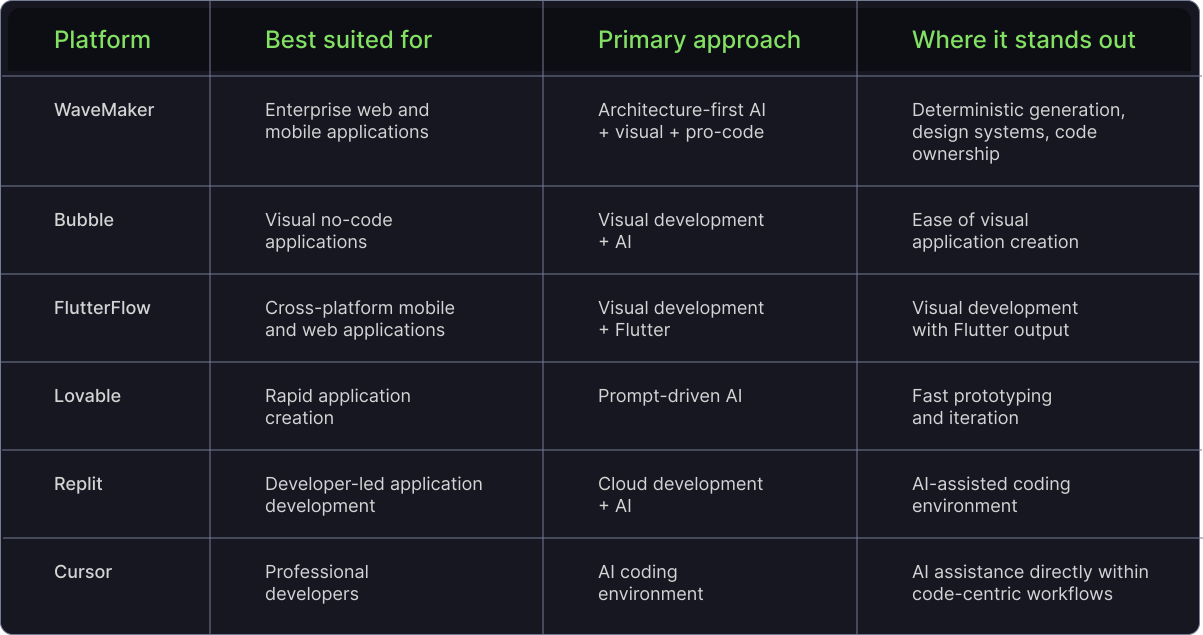
Some platforms are excellent for prototypes. Others are designed around visual development. Some are essentially AI coding environments. And a smaller group is beginning to approach application generation as an engineering problem, where architecture, design systems, governance, and code ownership are part of the generation process itself.

Recent 2026 comparisons also show how broad the AI app builder category has become, spanning prompt-driven builders, visual platforms, and developer-focused tools.

This guide compares popular AI-assisted application development options, including Bubble, FlutterFlow, Lovable, Replit, Cursor, and WaveMaker, and explains where each fits.


What is an AI app builder?

An AI app builder uses artificial intelligence to automate some or much of the application development process.

Instead of starting with an empty IDE and writing every component, a developer or product team can describe what they want using natural language, provide a design, connect an API, or work with an existing application. The AI then helps generate interfaces, application logic, integrations, code, or other development artifacts.

The exact experience varies considerably between platforms.

A prompt-first tool may generate a complete application from a description. A visual AI app builder may combine AI generation with a drag-and-drop development environment. A developer-oriented platform may use AI to write and modify code inside an existing repository.

That distinction matters because AI app builder is now being used as an umbrella term for several very different approaches to application development.

The best choice depends on what you are actually trying to build.


What should you look for in an AI app builder?

A useful AI app builder should do more than produce an impressive first draft.

For prototypes, speed and ease of use may be enough. For production applications, particularly those developed by enterprise teams, the evaluation needs to go deeper. Here are the capabilities worth looking at.

Best AI app builder platforms compared

There is no universal winner across every use case.

A startup validating an idea has very different requirements from a financial services company building a customer portal or an enterprise team modernizing an internal application.

The comparison is useful, but it is equally important to understand that these products don't all belong to exactly the same category. Some are visual application builders. Some are prompt-to-application tools. Others are AI coding environments. The best AI app builder for one team can therefore be a completely different choice for another.


1. WaveMaker: An architecture-first AI app builder for enterprise development

WaveMaker takes a different approach to AI-assisted application development.

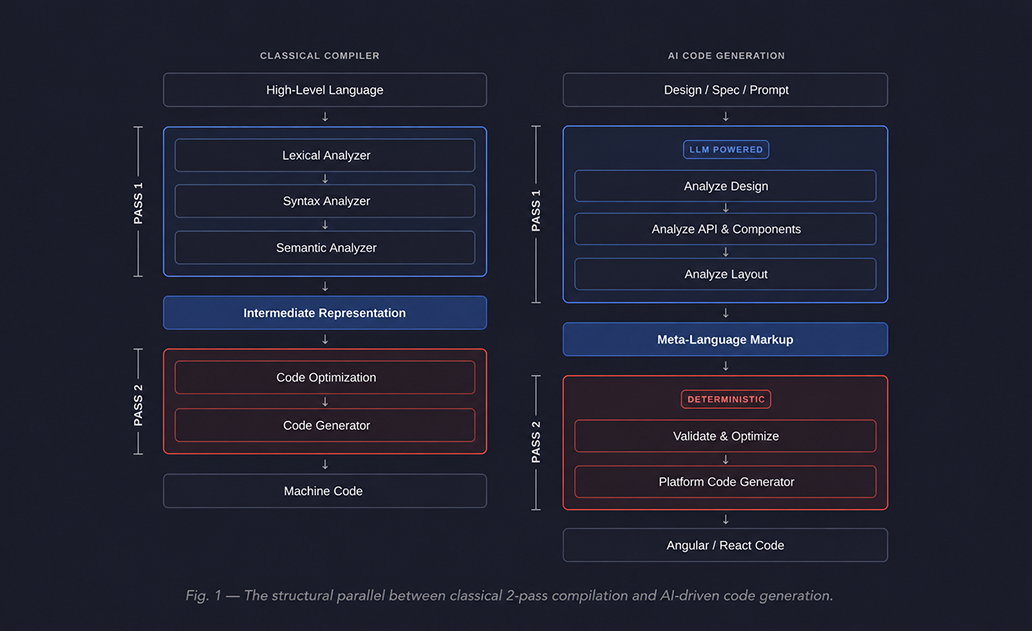
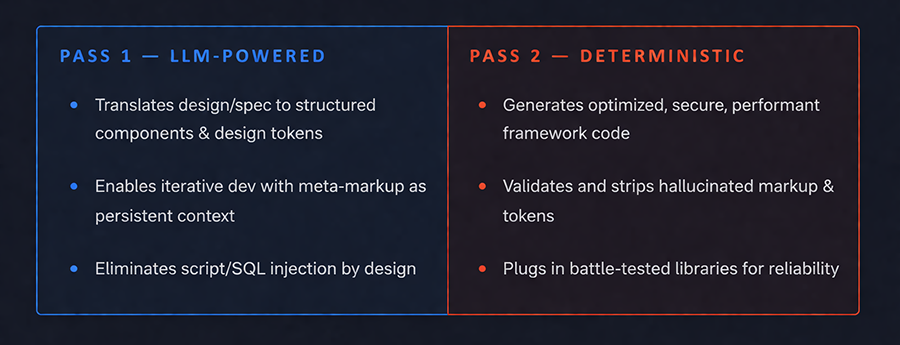
Instead of asking an AI model to generate framework-specific production code directly from every prompt, WaveMaker separates application intent from final code through a two-pass development model.

In the first pass, AI agents interpret design or prompt intent and generate a structured, stack-agnostic application representation called WaveMaker Markup Language, or WML.

Developers can then validate and refine that representation through WaveMaker Studio.

In the second pass, WaveMaker's template-based code generators convert the validated markup into application code for technologies including Angular, React, and React Native.

The idea behind this approach is straightforward: AI is useful for interpreting intent. Production software needs predictable implementation.


Why WaveMaker uses a two-pass approach

One of the challenges with purely prompt-driven development is that the same requirement can produce different implementations across iterations.

That can be useful when exploring ideas. It becomes less useful when a team is trying to maintain a large application.

WaveMaker's intermediate representation provides a structured point between AI interpretation and code generation. Its platform material describes the approach as a way to reduce inconsistencies and hallucinations while making application generation more controllable and repeatable.

The result is an AI app builder designed around a solid principle: use AI where interpretation and reasoning add value, and use deterministic generation where consistency matters.


Design-to-code is built into the workflow

Design is another area where WaveMaker takes a different approach.

Its Figma integration can convert designs into structured application artifacts, including design tokens and mapped components. Those artifacts can then be refined within the development environment.

This matters because an application can be technically functional and still feel inconsistent.

Different developers may interpret spacing, components, colors, typography, and interaction patterns differently. A design system gives the team a shared language.

WaveMaker brings that language into the generation process instead of relying entirely on developers to reproduce it through prompts.


Developers remain in control

The goal is not to hide the generated application behind an AI interface.

WaveMaker provides multiple ways to work with an application. Developers can move between agent-based interaction, visual editing, and direct code editing, allowing them to review and refine the generated result.

That human-in-the-loop approach is important for enterprise development.

AI can accelerate implementation, but developers still need to make architectural decisions, validate behavior, and take responsibility for what eventually ships.


The code belongs to the development team

This is another major consideration when evaluating an AI app builder.

WaveMaker generates standard code that development teams can extend, embed, export, and manage through their existing version-control workflows. The platform is built around open standards rather than requiring applications to remain dependent on a proprietary runtime.

That makes the platform particularly relevant for teams that want AI-assisted development without giving up ownership of the resulting software.

Best for: Enterprise web applications, mobile applications, design-heavy applications, modernization projects, and teams that need AI speed without giving up architecture and code ownership.


2. Bubble: A visual AI app builder for no-code development

Bubble approaches application development primarily through visual and no-code development.

Its strength is accessibility. Teams can visually create application interfaces, workflows, data structures, and functionality without building everything through traditional programming.

AI capabilities extend that visual development experience, making it easier to move from an idea toward a working application.

For teams that want to build without assembling a conventional development stack, Bubble can be an attractive option.

The question for an enterprise development team is different, though.

When evaluating any AI app builder, consider how its development model fits your requirements around architecture, source code, deployment, integration, and long-term ownership.

Best for: Visual no-code applications, internal tools, business workflows, and teams prioritizing ease of visual development.


3. FlutterFlow: A visual AI app builder for cross-platform development

FlutterFlow combines visual application development with Flutter.

That makes it particularly interesting for teams that want to build mobile and web applications through a visual workflow while targeting the Flutter ecosystem.

Its appeal comes from the ability to visually assemble interfaces and application behavior while retaining access to generated Flutter code.

As with any AI app builder, the important evaluation questions are less about whether it can generate an application and more about whether the technology, architecture, integrations, and development workflow match your requirements.

Best for: Teams building cross-platform applications where Flutter is the preferred technology.


4. Lovable: An AI app builder focused on speed and iteration

Lovable is representative of the prompt-to-application category. You describe what you want, and AI creates a working application that you can continue refining through natural-language interaction. This makes it particularly useful when the goal is to test an idea quickly.

A product manager can describe a workflow. A designer can explore an interface. A founder can validate an early product concept. A development team can use it to explore an idea before committing to a larger implementation.

That speed is the point.

But it also highlights why the phrase best AI app builder needs context.

A platform that is excellent for creating a prototype is not automatically the best platform for building a five-year enterprise system.

Best for: Prototypes, MVPs, product exploration, and rapid application experimentation.


5. Replit: AI-assisted development in a cloud coding environment

Replit sits closer to the developer side of the market. Rather than being purely a visual AI app builder, it combines a cloud development environment with AI-assisted coding and application creation. That makes it attractive to developers who want AI assistance while remaining relatively close to the underlying code.

The benefit is flexibility. The developer retains responsibility for the application's architecture, dependencies, technology choices, and long-term maintenance. For experienced developers, that can be exactly what they want.

Best for: Developers, technical teams, prototypes, and applications where direct control over the coding environment is important.


6. Cursor: An AI coding tool rather than a traditional AI app builder

Cursor frequently appears in conversations about AI application development, but it is useful to distinguish it from a conventional AI app builder. Cursor is fundamentally an AI-powered coding environment. A developer works with an existing repository and uses AI to generate, modify, explain, refactor, or debug code. That makes it powerful for experienced software engineers who already understand their architecture.

But Cursor does not attempt to replace the architectural role of the development team. The developer still defines the application's structure, technology choices, design patterns, and engineering standards.

This is an important distinction. An AI coding assistant helps a developer build faster. An architecture-first AI app builder attempts to make the development system itself more structured and repeatable.

Best for: Professional developers working with existing codebases and established engineering workflows.


AI app builder vs. AI coding tool: What's the difference?

The terms are increasingly used interchangeably, but they describe different experiences.

AI coding tools

An AI coding tool primarily helps a developer write and modify software. The developer owns the repository and architecture. AI accelerates implementation.

Prompt-to-app platforms

A prompt-to-app AI app builder moves further up the stack.

Instead of asking for individual code changes, the user describes an application or feature and the system generates a much larger portion of the implementation. This can dramatically shorten the path from idea to prototype.

Architecture-first application generation

An architecture-first AI app builder takes another step.

The goal is not simply to generate more code. It is to combine AI generation with application architecture, design systems, reusable components, structured intermediate representations, human validation, and SDLC processes.

That is the model WaveMaker is pursuing. Its platform combines AI agents with a two-pass generation architecture, design-to-code capabilities, an integrated Studio, enterprise integrations, and standard application code.

The distinction becomes particularly important when an application moves beyond experimentation.


Why production applications need more than AI-generated code

AI has become very good at producing working code. That doesn't mean every generated application is ready for production. The problem usually appears later. The first screen looks good. Then the team adds another feature. Then another developer changes the same component. An API changes. The design system evolves. A security requirement appears. The application needs to support another platform. The technology stack needs an upgrade. Suddenly, the quality of the initial generation is no longer the only thing that matters. The system needs to remain coherent.

WaveMaker's enterprise AI development material makes this distinction explicitly: AI-assisted development needs to move beyond individual productivity toward repeatable delivery across teams, with specifications, architecture, context, and guardrails embedded in the development system rather than repeatedly recreated through prompts.

That is the bigger challenge an enterprise AI app builder needs to solve.


The problem with prompt-only development

Prompt-based development is powerful because it is flexible. But flexibility can also introduce variability.

Different prompts can produce different architectural decisions. Different developers can use different instructions. As the application grows, developers may need to provide increasingly large amounts of context to keep the AI aligned with the existing codebase.

The result can be more review, more debugging, and more normalization work. The goal shouldn't be to remove human judgment. It should be to make human judgment more effective by giving the AI system a stronger architectural foundation.


What makes an AI app builder production-ready?

If you're evaluating an AI app builder for an enterprise application, don't judge it only through a polished demo.

Test it with a real application.

  1. Test the design system
    Give the platform an actual Figma design. Look at whether components, tokens, layouts, and interaction patterns survive the journey from design to application.
  2. Test the architecture 
    Generate more than one feature. Look at whether the resulting application follows the same patterns across modules.
  3. Test the APIs
    Connect the platform to the APIs your application actually needs. A simple demo API tells you very little about how the platform will handle real integrations.
  4. Test the generated code
    Ask your developers to inspect it. Can they understand it? Extend it? Put it into source control? Run their normal testing and review process?
  5. Test change
    This is perhaps the most revealing test. Generate an application, then change the requirements. Add a feature. Modify a screen. Change an API. Update a component. A production-oriented AI app builder should make change manageable rather than forcing the team to repeatedly rebuild the application from scratch.
  6. Test deployment
    Finally, determine whether the generated application can enter the organization's existing development and deployment workflow. WaveMaker is designed to integrate with Git, CI/CD, and enterprise deployment environments, with support for cloud and on-premise infrastructure.


Which AI app builder is best for enterprise developers?

There is no universal answer, but the criteria become much clearer for enterprise teams.

If the priority is a quick prototype, a prompt-first AI app builder may be the right choice.

If the priority is accelerating an experienced developer, an AI coding tool may make more sense.

If the team needs to build production applications while maintaining architectural consistency, design governance, code ownership, and SDLC integration, the evaluation changes.

This is where WaveMaker is differentiated.

Its architecture-first model is designed specifically around enterprise development teams building production-grade web and mobile applications. The platform combines AI agents, design systems, structured application markup, deterministic code generation, visual development, direct code access, security configuration, API integration, Git, and CI/CD support.

In other words, the goal is not simply:

Prompt → code

It is closer to:

Intent → structured application model → validation → governed code → deployment

That extra structure is what makes WaveMaker an interesting option for organizations that need AI-assisted development without treating production software like a disposable prototype.


How WaveMaker simplifies app development

WaveMaker brings several development activities into the same workflow. A team can begin with a prompt, a Figma design, a design screenshot or application requirements. AI agents can help interpret the intent and create application artifacts.

The developer can then review the result in Studio, switch between visual and code-based editing, connect APIs, refine the application, and configure the relevant development workflow.

Finally, the platform generates standard application code for supported web and mobile frameworks.

WaveMaker's product material describes this as a path from design systems to production-ready code, with agents handling development tasks while developers retain control over the resulting application.

This approach can reduce the amount of repetitive work developers need to do while keeping the development process recognizable to an engineering team.


The advantages of an architecture-first AI app builder

The biggest advantage isn't simply that AI writes code faster. It is that the AI is given a structure within which to work. For enterprise teams, that can translate into several practical benefits:


How to choose the best AI app builder for your team

Start with the application, not the tool.

Ask these questions:


So, what is the best AI app builder in 2026?

The answer depends on the job.

For visual no-code development, Bubble is a compelling option.

For cross-platform Flutter development, FlutterFlow deserves consideration.

For fast AI-generated prototypes, Lovable is well suited to the job.

For cloud-based AI-assisted development, Replit offers a developer-oriented approach.

For experienced developers who want AI directly inside their coding workflow, Cursor is a strong fit.

For enterprise teams building long-lived production applications, the requirements are different.

They need an AI app builder that can combine AI speed with architecture, design systems, developer control, code ownership, and enterprise development practices.

That is where WaveMaker is designed to fit.

Its two-pass architecture separates AI interpretation from deterministic code generation. Its design-to-code workflow brings Figma and design systems into application development. Its Studio gives developers visual, agentic, and code-based ways to work. And its generated application code can be owned, extended, version-controlled, and deployed by the customer team.

The broader shift is important.

AI-assisted development is moving beyond the question of "How quickly can AI create an application?"

The better question is:

"How quickly can my team create software that remains reliable, maintainable, and under our control?"

For organizations asking that question, an architecture-first AI app builder offers a different path: AI speed without giving up engineering discipline.


Frequently Asked Questions

What is an AI-powered app builder and how does it work?

An AI-powered app builder uses AI to turn application requirements, prompts, designs, or existing context into working application artifacts. Depending on the platform, that can include UI components, application logic, APIs, integrations, and code.

The important difference between platforms is what happens between the initial request and the final application. Some generate code directly from a prompt. WaveMaker takes a two-pass route: AI first translates intent into structured WaveMaker Markup Language, which developers can review and refine before the platform generates application code for frameworks such as Angular, React, and React Native.


What makes the WaveMaker AI app builder unique?

WaveMaker combines AI-assisted development with an architecture-first approach. Instead of treating AI as a layer that simply writes code, the platform builds architecture, components, design tokens, application patterns, and development guardrails into the generation process.

Its two-pass model is central to that approach. AI interprets application intent into a structured intermediate representation, while a template-based generator produces the final application code. Developers can also move between agent mode, visual editing, and code editing during development.


Which AI app builder is best for enterprise developers?

The best option depends on the application and the team's existing development process. Enterprise developers generally need more than fast code generation. They need control over architecture, source code, security, integrations, testing, deployment, and long-term maintenance.

WaveMaker is designed specifically around those requirements. It combines AI agents with design systems, structured application generation, standard web and mobile frameworks, code ownership, Git and CI/CD integration, and developer-controlled workflows.


What features does WaveMaker AI app builder offer?

WaveMaker combines several capabilities in one development environment. These include two-pass AI-assisted application generation, Figma-to-code design automation, an enterprise component and design-token system, AI agents for application development tasks, visual Studio, direct code editing, API integration, security configuration, Git and CI/CD support, and generation for Angular, React, and React Native applications.

It also supports a human-in-the-loop workflow, allowing developers to review and refine generated applications instead of handing complete control to an AI model.


How does WaveMaker AI app builder compare with other options?

The main difference is what the platform is optimizing for.

Prompt-first tools generally focus on getting from an idea to a working application quickly. AI coding environments focus on helping developers write and modify code faster. Visual builders emphasize assembling applications without traditional coding.

WaveMaker is focused on a different requirement: helping enterprise development teams build production applications with AI while maintaining architectural consistency, design governance, code ownership, and control. Its two-pass architecture, design-to-code workflow, standard framework output, and SDLC integration are designed around that goal.

An Agentic Software Revolution, but with non-determinism at its core

Non-determinism, drift, relinquished control, and the harnesses enterprises must build

Agentic AI changes how organizations automate workflows that help make decisions autonomously. Agentic coding changes how software gets built. Looked at separately, both run into the same underlying problem: non-determinism, in what an agent decides and in what an agent generates.

Agentic AI is not replacing software, though. The agent is itself a new kind of software, one that shifts the work from writing logic line by line to orchestrating systems and validating outcomes.

Two Decades of Software Evolution

Software has evolved over the last two decades to remove the bottlenecks between developers, systems, and the business users waiting on them – as organizations scaled, embraced new technology trends, and adapted to constant business change.

Frameworks, and the first wave of workflow automation

Programming languages gave way to enterprise frameworks – J2EE, .NET, Spring, Ruby on Rails etc., that gave professional developers structure and reuse. Around that same era, workflow automation software emerged on top of these frameworks, letting business consultants configure and run business processes without a professional developer writing every step.

SaaS and low-code platforms gave rise to the citizen developer

SaaS and low-code platforms emerged during the cloud-era and as these platforms matured, a new kind of builder emerged to use them: the citizen developer, solving automation needs directly through workflows and purpose-built apps, without waiting on a professional developer for every change to the software system.

Open-source frameworks evolved for professional developers with an expanding open source ecosystem, while most SaaS and low-code platforms were proprietary. Across this period, software development settled into two tracks:

  1. one for professional developers, and
  2. one for citizen developers.

Agentic AI continues the citizen developer rise

Agentic AI lets citizen developers build agents that automate workflows and run autonomously, without writing software at all. As agentic AI platforms mature, this model is moving beyond individual workflow automation toward broader agentic AI applications.

Generative AI gave citizen developers vibe coding, assembling applications directly from plain-English intent, and gave professional developers AI-assisted coding, a copilot for writing code faster without changing who owns the review or the architecture.

Two very different things get produced: decisions and code

An agent takes in a situation, decides what to do about it, and acts, without a human specifying each step beforehand. Code whether produced by hand, by a copilot, or from a prompt — is deterministic and with proper review and verification becomes ready for deployment.

Which is why software can’t be replaced with agents

Agents help make decisions, but they still run on top of everything the organization already built. They call APIs, query databases, and act through business services that have to exist and be maintained.

And a great deal of what an enterprise runs cannot be handed to a probabilistic system at all. Banking ledgers, payment processing, inventory controls, systems of record — these need absolute predictability, low latency, and an audit trail for compliance. That’s the deterministic core, and agents orchestrate around it rather than replacing it.

This distinction is particularly important when designing agentic AI applications for enterprise environments, where autonomous reasoning still has to operate within deterministic systems of record.

Agentic AI is a Distinct Computational Paradigm

Agentic AI reasons its way to an outcome rather than executing a path someone specified in advance. That shift demands an architecture of its own — an agentic AI architecture designed to govern how the agent perceives, reasons, and acts:

In practice, these components form the foundation of many agentic AI frameworks and platforms, but the architecture around the model is what determines how much control an organization retains.

In traditional software, both the data and the environment change between a pilot and production – different volume, edge cases, users, and infrastructure – but the logic that processes all of it doesn’t change. That’s what makes traditional software deterministic.

An agent doesn’t run on written logic. At its core sits a pre-trained model that interprets whatever is in front of it and decides on its own, and it will keep doing that unless guardrails constrain it. So the logic path – the one thing traditional software held constant – becomes a variable.

A skill that behaves correctly in a clean pilot can behave differently in production the moment it meets messier context or an unexpected tool response. Call it behavioral drift: the same agent, the same skill, reaching a different conclusion because the situation around it changed. It is not a defect to be patched out. It is what a reasoning system does, and it is why so few pilots survive in production, by McKinsey’s 2026 count, 88% never graduate, with evaluation gaps and model reliability the most cited reasons.


Agentic AI Makes Organizations gradually Relinquish Control over Data and Decisions

Who is actually making the decisions?

Where large organizations have taken agentic AI into production tells the story: customer support, fraud and dispute resolution, IT ticket resolution, workflow automation across systems. None of these decisions are new. Software has routed them for years, as long as the information arrived as a field it could read.

A claim amount is a field. The adjuster’s note attached to it is not, so someone had to read that note, decide what it meant, and enter the decision before anything downstream could move. That step is what agentic AI removed.

The judgment itself hasn’t changed hands. It still belongs to the business user — the thresholds they approve against, the conditions that warrant escalation, the exceptions they’ve learned to treat differently. A citizen developer writes the skill, but the business user’s overrides are what correct it. And given behavioral drift, those corrections are the only thing keeping a skill anchored to what the organization considers correct.

The decision-maker isn’t displaced; they become the control surface. What is displaced is something the organization notices much later.

AI Agentic software development


What the organization gives up instead

The displacement worth worrying about isn’t of people, but it’s the control.

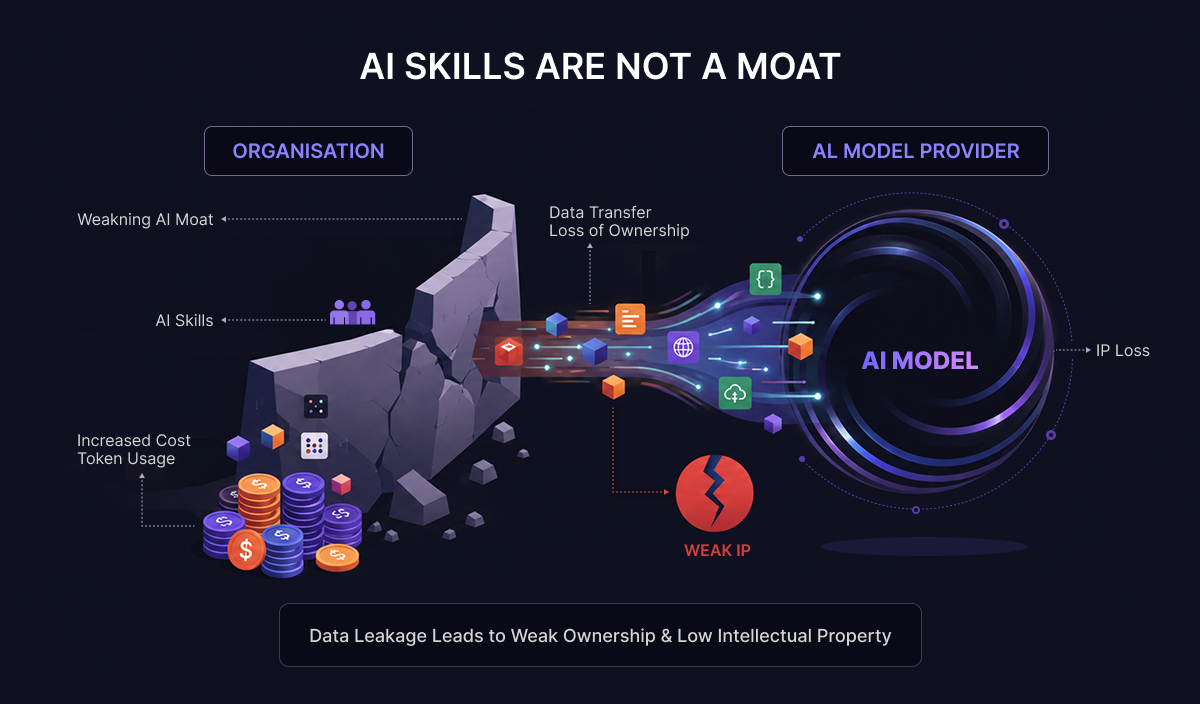
On one side is everything the organization built: its skills, its people, its accumulated judgment. But an AI skill is just plain-English instruction written against a third-party model reached through an API. It’s easy to replicate, the model is available to everyone, and the capability doing the work sits in the model, with a little bit of guidance provided in the instructions wrapped around it. Two competitors can assemble near-identical skill libraries and differentiate on nothing.

On the other side is the model provider, gaining control of the documents, customer records, and internal decisions crossing that boundary with every execution. Without a policy governing what context can be sent, and a way to halt an agent that strays outside its scope, proprietary information transfers out steadily.

This is why AI governance is not an optional layer around agentic AI architecture. It is part of the architecture.

The token spend that drain margins

Every reasoning step, tool call, and retry consumes tokens, and that spend tracks how often an agent runs rather than what it produces. A workflow that looked inexpensive across a few hundred pilot cases carries no natural ceiling once it reaches thousands of decisions a day.

This is an important consideration when evaluating agentic AI solutions. The question is not only whether an agent can perform a task, but what every execution costs and how that cost changes at production scale.

Fine-tune and own the model, don’t hand it all to a model provider

Deliberate decisions about which workflows belong in an agent, then owning what those agents run on is very critical for stakeholders. An open-weight model — Inkling, Qwen Coder, DeepSeek, GLM etc. — fine-tuned on an organization’s own domain and decision history keeps that judgment inside the organization, instead of handing over every decision and the learning that comes with it to a 3rd party model provider.


Agentic Coding makes Software Creation Faster, But Progressively Harder to Govern

Where the coding agent stops

Agentic AI coding takes intent, a problem spec, and a technology stack, and turns it into working code. That’s a real shift in how software gets written — and it stops there. The agent hands over source code and exits. Everything that turns that code into a running system still has to happen.

This is also where agentic AI development differs from simply using generative AI for code completion: the coding agent can reason across a task and execute multiple development actions rather than simply generate a code snippet.

Speed and quality are not the same thing

These tools are built to do one thing well: produce code fast, at volume, from a prompt. That’s genuinely useful, but it isn’t the same as producing code that’s architecturally sound, secure, or maintainable.

Coding agents don’t know your organization

They generate what looks plausible, not what actually fits. Ask for a payment authorization screen and you’ll get one — rendering correctly, passing its tests, and missing the auth check your platform team mandates on every transactional route, because nothing told the agent that rule exists. Human review, automated tests, and business validation still have to clear every generated artifact before it ships.

Non-determinism shows up here too, as architectural drift

The same variability that makes an agent’s decisions unpredictable makes a coding agent’s output inconsistent from one generation to the next. Ask for the same capability twice and the approach differs. Individually each answer looks reasonable; accumulated across a codebase, they pull the system away from its intended shape.

That’s architectural drift, sometimes leading to a security exposure, as dependencies multiply faster than anyone tracks them, and design system drift, where components work on their own but stop looking like one coherent product.

The token cost doesn’t stop at launch

Every bug fix, enhancement, and version upgrade re-runs the same generate-and-verify cycle, consuming tokens against the context needed to keep output grounded. Unlike traditional development, where cost falls as the codebase stabilizes, this spend keeps compounding release after release.


The fix is a harness, not a better prompt

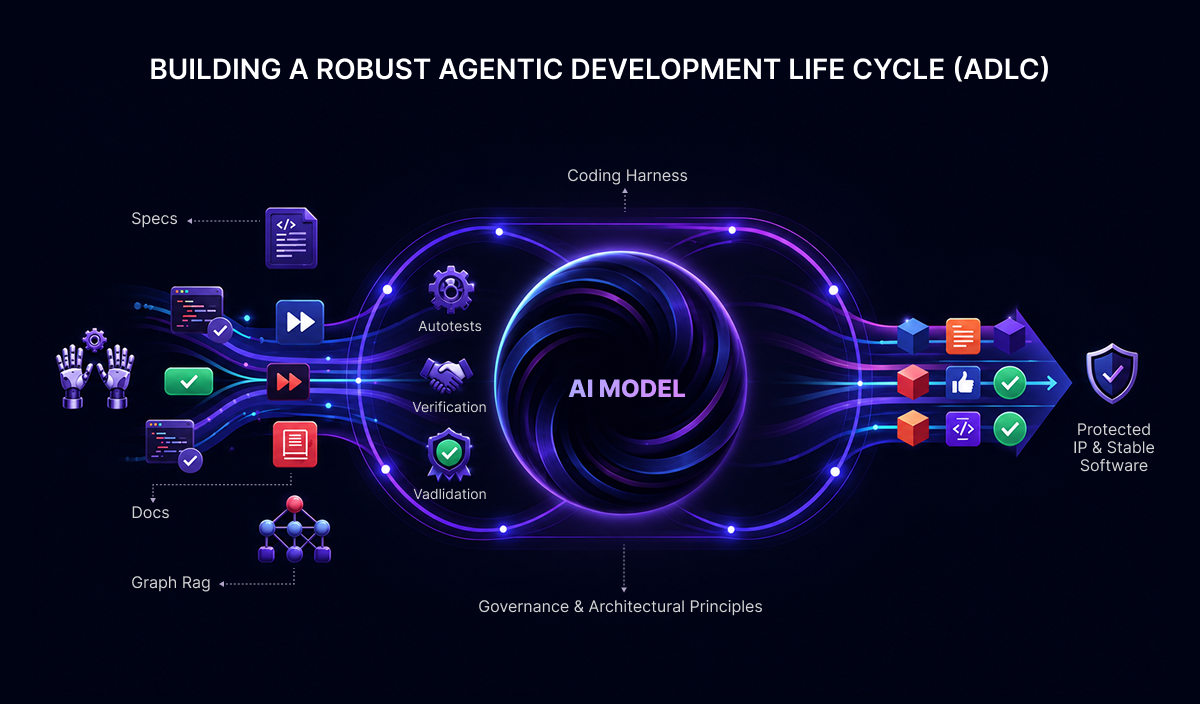
Closing the gap requires building a harness that belongs to the organization’s coding needs: architecture defined up front, retrieval of verified, curated code references and documentation, and guardrails applied at the point of generation.

This is becoming a core consideration for agentic AI solutions, because the value of an agent depends not only on what the underlying model can generate, but on how reliably the organization can constrain, validate, and govern its behavior.

This is the discipline of the SDLC rebuilt for the agentic era — an ADLC, an agentic development life cycle — with the same rigor around review, testing, and governance software teams always relied on. Most organizations haven’t defined one yet, which is why the drift and the cost both keep compounding.


Five Things Worth Taking Away

Agentic AI is a distinct computational paradigm — harness, context, skills, tools, memory. Agentic coding is a faster way to produce code that still has to earn its way into production. These elements form the foundation of modern agentic AI architecture, frameworks, and platforms.

Non-determinism runs through both, in different forms. Agents show behavioral drift, where the logic path changes between pilot and production. Generated code shows architectural drift, where output varies release to release and accumulates as security and design inconsistency.

Agents operationalize business users’ decisions rather than replacing them. The judgment still belongs to the business user, and their overrides are what keep a skill accurate — which makes removing them from the loop the wrong efficiency to chase.

What both trends quietly cost is control — Data and decision execution move to a third-party model; architecture erodes on the other. A harness is the moat: a policy layer and a fine-tuned model for agents, an ADLC for generated code.

Token spend scales with usage, not value, and never settles. Agent execution costs grow with every decision; generated code re-runs the same cycle through every fix and upgrade. That's a margin question worth answering before scaling past a pilot.

As agentic AI development moves from experimentation to production, organizations will increasingly evaluate agentic AI platforms, frameworks, and solutions not only by how much autonomy they provide, but by how effectively they preserve control, determinism, security, and ownership.

This blog is originally published on substack.


Frequently Asked Questions About Agentic AI and Agentic Software

What is agentic AI and how does it function?

Agentic AI refers to AI systems that can interpret a goal, understand context, make decisions, use tools, and take actions with a degree of autonomy. Unlike a conventional software system that follows predefined logic, an agent can determine what to do based on the situation it encounters.

An agentic AI system typically combines a model with context, skills, tools, memory, and a harness that controls how the agent operates.

What is agentic AI and how does it differ from other AI types?

Traditional AI systems typically execute predefined rules or perform specific predictive tasks. Generative AI creates new content based on learned patterns. Agentic AI adds another layer: the ability to interpret goals, reason about actions, use tools, and execute tasks with varying levels of autonomy.

This makes agentic AI a distinct computational paradigm rather than simply another form of content generation.

What are the best agentic AI tools for software development?

The best agentic AI tool depends on the development team's technology stack, workflow, security requirements, and level of autonomy required. Agentic AI coding tools can assist with code generation, debugging, testing, refactoring, and repository-level tasks.

For enterprise development, organizations should evaluate these tools on more than coding speed. Architecture consistency, security, governance, maintainability, code ownership, context control, and validation are equally important.

What is the best coding tool for agentic AI development?

There is no single best coding tool for every development team. The right tool depends on the team's programming languages, frameworks, repository structure, security requirements, deployment environment, and governance model.

For enterprise agentic AI development, important evaluation criteria include architectural consistency, code ownership, testing, security, context grounding, reproducibility, maintainability, and governance — not just code generation speed.

What is an agentic AI coding tool and how does it work?

An agentic AI coding tool applies agent-based reasoning to software development. It can interpret a requirement, inspect relevant code and documentation, determine implementation steps, generate or modify code, use development tools, run tests, and iterate based on the results.

The reliability of an agentic coding tool depends not only on the underlying AI model but also on the context, tools, guardrails, and validation mechanisms surrounding it.

What features can I expect from an agentic coding assistant?

An agentic coding assistant can provide capabilities such as:

Enterprise environments may also require architecture controls, security guardrails, governance, auditability, and human review.

What exactly is agentic code?

Agentic code generally refers to software created, modified, or operated through agentic systems. In software development, it can describe code generated or changed by autonomous coding agents.

The important distinction is that the generated code itself remains conventional executable software. The agentic behavior comes from the system that reasons about what code needs to be created or changed and how the task should be completed.

What are the key features of agentic software?

Key features of agentic software include goal-oriented behavior, contextual reasoning, tool use, multi-step execution, memory, planning, feedback loops, and autonomous or semi-autonomous action.

The level of autonomy depends on the architecture, tools, permissions, guardrails, and human oversight surrounding the agent.

What are the key concepts in agentic software engineering?

Key concepts in agentic software engineering include agentic AI architecture, context, skills, tools, memory, orchestration, evaluation, guardrails, observability, governance, and human-in-the-loop validation.

For enterprise software, architecture and validation are particularly important because probabilistic AI behavior must ultimately produce software and decisions that organizations can control and trust.

What is the relationship between software factories and the agentic moment?

Software factories industrialize software production through standardized processes, reusable components, automation, and engineering systems.

The agentic moment extends this model by introducing autonomous AI systems into software production. Agents can increasingly participate in requirements, coding, testing, documentation, and other development activities.

This makes architecture, validation, governance, and reproducibility increasingly important because the software factory now has probabilistic actors participating in the production process.

WaveMaker’s Agentic App Generation System: Interview With Head Of Product Experience Vikram Srivats

WaveMaker is an architecture-first, agentic AI-based web and mobile application generation system for early developer teams in enterprises and midmarket businesses. As Head of Product Experience, Vikram Srivats is responsible for all aspects of product-market fit, including driving go-to-market (GTM) strategy. Pulse 2.0 interviewed Vikram Srivats for this article.

Vikram Srivats’ Background

Could you tell me more about your background? Srivats said:

“I’m a Mechanical engineer by training with a graduate degree from India’s top science university, the Indian Institute of Science, who somehow ended up in the fascinating intersection of hi-tech and software products with enterprise customers since I started over 20 years ago.”

“My career has followed a pattern: I keep finding myself at the early stage of hard technology problems where the product-market fit isn’t obvious yet, and the job is to figure out what matters to customers, build the narrative, and scale it. At Mindtree, a $3 billion revenue company today, I was the founding general manager of an Internet of Things business that I incubated from scratch. Before that, I took over a brilliant team and an R&D lab and helped establish it as the number-one independent licensor of Bluetooth Smart silicon and software IP globally. Earlier in my career, I shaped the enterprise go-to-market for what was arguably India’s first indigenous handheld computer, a product built to address the digital divide.”

“I’m genuinely moved by making possibilities real and have always been drawn to the moment when a product or technology goes from being technically impressive to being genuinely useful to a business. That’s what drew me to WaveMaker. When I joined, the company had a deeply sound technical foundation, a decade of deterministic code generation, enterprise-grade architecture, and zero lock-in, but the world didn’t yet fully appreciate why that mattered. Then AI changed everything, and suddenly, the case for determinism became the most important conversation in enterprise software. I’ve held several roles at WaveMaker, including VP of Strategic Markets, making deep inroads in the world of financial services and software. Today, as Head of Agentic Product Experience, I’m responsible for the end-to-end product experience of our agentic application generation platform from how customers first encounter WaveMaker to how their development teams use it daily to ship production software.”

“I also write regularly on Substack about the themes I care about: why deterministic software engineering is making a comeback, why design quality matters more (not less) in the AI era, and how enterprise development teams can navigate the hype cycle without losing their footing.”


Formation Of The Company

How did the idea for the company come together? Srivats shared:

“WaveMaker’s story starts with Pramati (meaning ‘exceptional minds’), our parent company, which was founded in 1998 by Jay and Vijay Pullur in Hyderabad. Pramati built the world’s first J2EE-certified application server, competing directly against Oracle, BEA, and IBM, and winning. By 2001, every one of India’s top ten banks ran on Pramati infrastructure. That’s the DNA: enterprise-grade platform technology built under intense competitive pressure.”

“In 2013, Pramati acquired the WaveMaker product from VMware and set out to solve a problem the team had experienced firsthand: enterprise application development was too slow, too expensive, and too dependent on scarce full-stack talent. But every platform that promised acceleration imposed proprietary lock-in that professional developers couldn’t accept.”

“The founding bet was radical for the low-code market at the time: generate standard open-source framework code, Java, Angular, Spring, with absolutely zero proprietary runtime. Customers would own their code completely and could walk away at any time. That decision meant WaveMaker couldn’t compete on the same “magic” promises as platforms that locked customers in. It was the harder path. But it built something more durable: trust from enterprise engineering teams who had been burned by vendor lock-in before.”


Favorite Memory

What has been your favorite memory working for the company so far? Srivats reflected:

“There’s a moment I keep coming back to. It was during a proof-of-concept with a large financial services company who had evaluated 17 different platforms across 30 criteria before even talking to us seriously. They were rigorous, skeptical, and had very specific requirements: on-premise deployment, Sybase database connectivity, AG-Grid and Highcharts integration, role-based access control. The kind of list that most demo-friendly platforms quietly fail on.”
“Our team ran a multi-phase evaluation with their engineers. At the end, their MD did the math: 4x FTE leverage during the PoC. But what stuck with me wasn’t the number. It was something one of their engineers said after the evaluation: ‘WaveMaker checked most of the boxes, and we actually trust the code it produces.’ That word “trust” from a professional developer evaluating the output of a platform, is the highest compliment this kind of product can receive. It validated everything we’d built.”

What are the company’s core products and features? Srivats explained:

“WaveMaker’s Agentic Application Generation Platform is built for enterprise developer teams shipping production-grade web and native mobile applications. The core innovation is a two-pass architecture that separates what AI is great at from what AI is terrible at.”

“In the first pass, AI agents, constrained by a Model Context Protocol trained on a decade of production application patterns, convert design intent into WaveMaker Markup Language, or WML. This is a compact, structured, language-agnostic intermediate representation. In the second pass, a proven template-based code generator converts WML into production-ready code: Angular, React, or React Native on the frontend, Spring and Hibernate on the backend. Same input, same output, every time. No hallucinations, no phantom dependencies.”

“Around that core architecture, we deliver: Design-to-Code agent, a Figma plugin for design-to-code conversion with full design token propagation; a rich enterprise UI component library built on Material 3; a visual WYSIWYG Studio where developers can toggle between agent mode, visual mode, and code editor mode; built-in security configuration covering RBAC, SSO, OAuth, and MFA; API integration via Open API and Swagger; and native Git and CI/CD pipeline support. The generated code is standard open-source frameworks that are downloadable, deployable anywhere, with zero runtime lock-in.”


Challenges Faced

Have you faced any challenges in your sector recently? Srivats acknowledged:

“The biggest challenge has been navigating the gap between AI coding hype and enterprise reality. The market narrative in 2024-25 was intoxicating: AI will write all the software, everyone becomes a programmer, development costs drop to near zero. That narrative attracted enormous venture funding and media attention to tools like Cursor, Copilot, Replit, and v0.”
“But enterprise teams who adopted these tools encountered a set of problems the hype cycle glossed over. AI-generated code introduces 1.7 times more issues than human-written code. Security flaws appear in 45% of AI output. 67% of developers report spending more time debugging AI-generated code than writing it themselves. Google’s own DORA report showed a 7.2% drop in delivery stability among teams using AI tools.”

“For WaveMaker, the challenge was positioning ourselves in a market where “AI coding” had become synonymous with raw, non-deterministic code generation when our approach was architecturally different. We had to educate the market that speed without reliability isn’t acceleration, it’s chaos with better marketing. The two-pass architecture, the constrained markup layer, the deterministic second pass, these are the concepts that required explanation in a world conditioned to judge AI tools by how fast they produced code. We overcame it by leaning into thought leadership, publishing research, and letting architecture speak for itself in customer evaluations.”


Evolution Of The Company’s Technology

How has the company’s technology evolved since launching? Srivats noted:

“WaveMaker started as a WYSIWYG, open-standards development studio, which is essentially a visual IDE that generated real Java and Angular code instead of proprietary artifacts. That was already differentiated in the low-code market, but it was fundamentally a visual development tool.”

“The first major evolution was adding a native mobile application studio. We delivered a React Native code generation engine for our enterprise customers and software companies who wanted to deliver a cross-platform companion or deskless high-fidelity application to their users or customers. The second was the composable architecture, enabling teams to build reusable components and assemble enterprise applications from modular building blocks, including supporting micro-frontend patterns.”

“The most consequential evolution came in 2025-26 with the introduction of AI agents and the two-pass architecture. Rather than adding AI as a chatbot sidebar, which is what most platforms did, we rearchitected the generation pipeline. We leaned in on our WaveMaker Markup Language (WML) as an intermediate representation, constrained AI through MCP, and kept the deterministic code generator as the final pass. This wasn’t an incremental feature; it was a fundamental architectural decision that redefined what the platform is: from a visual development studio to an agentic application generation platform. The Figma-to-app pipeline, the agent framework for custom domain-specific agents, and the style workspace for design system management were all built on top of this new architecture.”


Significant Milestones

What have been some of the company’s most significant milestones? Srivats cited:

“Several milestones stand out across our history. In 2014, we launched WaveMaker Online as one of the first cloud-based developer studios using Docker container orchestration provisioning developer workspaces in seconds, which was pioneering at the time. Building a customer base across 17 countries with enterprise clients like FICO, FIS, and AT&T validated that professional developers would adopt a platform that respected their code ownership. In 2023, WaveMaker was recognized by five industry analysts in a single year, including a position in the Omdia Universe for No Code/Low Code Solutions. In February 2025, we launched our AI-powered Figma-to-code plugin. In February 2026, we officially entered the agentic era with the launch of the two-pass architecture and the full agentic platform. That same month, our WaveXD 5G-integrated application marketplace won the Juniper Research Future Digital Award for Telco Innovation. And our collaboration with AT&T on mobile application experiences for influencer MVNOs opened an entirely new market vertical. Today, applications built using WaveMaker’s platform are shipping to millions of end users and consumers in the U.S. and globally.”


Customer Success Stories

Can you share any specific customer success stories? Srivats highlighted:

“For some of our customers who are large US public corporations in financial services and telecommunications, delivering to their exacting requirements around integration, UX, performance, security, and architectural governance in themselves has been a tremendous success. In a particular case, WaveMaker’s powered a mobile-first digital banking platform that is being used by millions of consumers with very high app store ratings. That is what we mean by enterprise-grade and consumer-scale, especially in these regulated industries where the code quality, security posture, and architectural consistency of generated applications isn’t optional, it’s audited.”

“We have helped Indonesia’s state owned petrochemical company completely rearchitect and migrate from over a 100 legacy Lotus Notes applications to a modern, rationalized Java/Angular based application stack within months. Belgium’s largest supermarket retailer, Colruyt Group, uses WaveMaker as a standardized accelerator for early developer teams, delivering architecture and guardrails out of the box. Blue Yonder, a global supply chain software leader, uses WaveMaker to support extensibility in areas of their supply chain solutions. These relationships span years, not quarters, which is the real test of an enterprise platform. Our enterprise customer base has experienced minimal churn which tells you more about product-market fit than any marketing metric.”


Funding/Revenue

Are you able to discuss funding and/or revenue metrics? Srivats said:

“WaveMaker is a Pramati group company, and Pramati has been self-funded for over two decades with group company revenues and proceeds from M&A. It gives us the freedom to make product decisions based on what’s right for customers on a multi-year horizon.”

“Pramati’s track record includes building and exiting multiple portfolio companies: Qontext (social platform for enterprise collaboration) was acquired by Autodesk, Imaginea (Cloud services) was acquired by Accenture, and SpotCues (deskless worker platform) was acquired by UKG in 2022. These exits demonstrate the ability to build durable products that attract acquirers, while the parent company maintains independence and continues investing in new ventures.”

“WaveMaker has grown net subscriptions every year since 2016. Our licensing model is annual subscriptions based on developer seats, with zero runtime fees which means our revenue scales with customer adoption, not with production usage metering. We currently serve customers across 17 countries.”


Total Addressable Market (TAM)

What total addressable market (TAM) size is the company pursuing? Srivats assessed:

“The global enterprise application market is projected to grow from $320 billion to $626 billion by 2030, according to some estimates. Within that, the AI code generation market is expected to reach approximately $25 billion by 2030. WaveMaker sits at the intersection of both: enterprise application development accelerated by AI.”

“Our specific addressable market is in midmarket with early developer teams building custom, UI-heavy, multi-platform web and mobile applications, particularly in financial services, insurance, telecommunications, supply chain, and enterprise software. These are organizations with 5 to 500 developers who need production-grade output, architectural governance, and predictable costs not weekend prototyping tools or individual coding accelerators.”


Differentiation From The Competition

What differentiates the company from its competition? Srivats affirmed:

“The competitive landscape segments into four categories, and WaveMaker occupies a distinct position in each comparison.”

“Against coding accelerators like Cursor and Claude Code: they make individual senior developers faster; WaveMaker normalizes output quality across entire teams through constrained markup generation and deterministic code output. They have no design system awareness; we treat design systems as first-class architectural artifacts.”

“Against vibe coding platforms like v0 and Lovable: they excel at beautiful prototypes; WaveMaker is built for production. They’re locked to specific ecosystems (v0 to Vercel/Next.js); we generate standard code deployable anywhere.”

“Against design-to-code tools like Locofy: they convert Figma to frontend code; WaveMaker goes full-stack, frontend, backend, API integration, security, deployment, all from a single specification.”

“Against enterprise low-code platforms like OutSystems: they require proprietary runtimes and certified developers; WaveMaker generates standard Angular, React, React Native, and Spring Boot with zero lock-in. Any Java/JavaScript developer can work with our output.”

“The unique combination of deterministic output, design system governance, full-stack generation, multi-platform targeting, and zero runtime lock-in exists nowhere else in this landscape simultaneously.”


Future Company Goals

What are some of the company’s future goals? Srivats emphasized:

“Near-term, we’re focused on expanding early access adoption for the agentic platform and demonstrating the two-pass architecture in production customer environments. We want enterprise teams to experience firsthand what it means to go from Figma design to deployed multi-platform application with deterministic, auditable code.”

“We’re deepening our agent framework so organizations can build custom domain-specific agents that inherit the same reliability guarantees — imagine a financial compliance agent or a supply chain integration agent that produces governed, deterministic output for highly specialized workflows.”

“On the market side, we’re expanding our system integrator partner ecosystem and strengthening our presence in financial services, insurance, telecommunications, and supply chain.”

“Longer-term, we believe the enterprise application development market is heading towards an agent-driven generation model with guardrails and architecture built-in — where AI composes interfaces dynamically from governed component libraries, adapting to each user’s context and role. WaveMaker’s design system infrastructure and WML architecture are the foundation for that future. We’re building toward it deliberately.”


Additional Thoughts

Any other topics you would like to discuss? Srivats concluded:

“One thing I think about a lot, borrowing from a recent article authored by my colleague and CTO, Deepak Anupalli, is the paradox of UX in the AI era. There’s a widespread assumption that AI will simplify interfaces to the point where design doesn’t matter. The reality is the opposite.”

“As AI automates away the easy, repetitive interactions such routine data entry, and simple form filling and what remains are the high-stakes decisions: a wealth advisor approving a million-dollar portfolio rebalancing, a supply chain manager responding to a stockout alert, a compliance officer reviewing an AI-generated audit narrative. These interactions don’t need less design; they need profoundly better design. The UX becomes the trust surface.”

“Enterprise applications typically blend five distinct interaction types — transactional, exploratory, data entry, analytical, and adaptive agentic — each with different trust requirements. A single generic AI-generated UI cannot serve them all. That’s why WaveMaker’s design-governed approach matters: we ensure that each interaction type gets the trust-appropriate UX treatment it requires, enforced through the generation pipeline rather than hoped for through documentation.”

“I believe the companies that understand this – that design is the guardrail AI needs, not decoration AI replaces — are the ones that will build lasting enterprise software in this era. That’s the thesis WaveMaker is built on, and it’s what drives me each day.”

This interview is originally published on Pulse 2.0.

Horses and Tigers Are Different : Why AI Is Unlike Every Technology Platform Shift Before It

AI differs from previous technology waves because it increasingly performs the implementation work that historically created demand for IT services. Drawing on 35 years of experience across ERP, SaaS, cloud, and AI, Vijay Pullur argues that the future belongs to organizations that transform domain expertise into proprietary software products rather than relying solely on labor-based services.

The rapid rise of large language model platforms – Anthropic, OpenAI, Google Gemini – has put the global IT services model in serious jeopardy of becoming obsolete. Dramatic as that sounds, I believe it is precisely the right framing.

Since January 20th, shares of virtually every major global IT services company have dropped between 20 and 30 percent. Accenture is down roughly 30 percent. IBM is down 24% with a single-day 13% decline around February 23rd-24th. Wipro and Coforge have shed nearly 25 percent. TCS, Infosys and HCL Tech are all trading at multi-year Lows.

The only comparable sector decline in such a compressed window was COVID-era 2020 – except that time, the Dow Jones fell 39 percent alongside them. This time, the Dow is essentially flat.

The broader economy is not in crisis. It’s the IT services business model that the market is repricing – and it is signaling a seismic shift.

Previous Platform Shifts AI
Needed implementation partners Performs implementation
Expanded services demand Compresses some services demand
Separate product and service Increasingly combines them
More consultants required More automation possible


AI Platform for app development Wavemaker

Mounting the Horse: A 35-Year Playbook

AI impacting traditional revenue models built around human capital seems to be the central story for this collapse. However, nearly every major IT services firm has announced an AI partnership. Accenture joined OpenAI’s Frontier Alliance alongside McKinsey, BCG, and Capgemini. TCS, Infosys, and Wipro all have deals with Anthropic, OpenAI, or Google.

In previous cycles, announcements like these would lift a company’s stock for weeks. This time, Accenture’s shares fell 6.6 percent on the very day it announced its OpenAI partnership. The market is not buying the story.

The 35-year IT services playbook used to be: announce a partnership with the rising platform, stand up a competency center, train people, and use the partner’s brand to win enterprise contracts. SAP and Oracle in the ’90s for ERP implementation. Salesforce in the 2000s for SaaS-led services. AWS, Azure, and Google Cloud in the 2010s for Cloud migration. Each time, the software platforms made clear that services were not their business. They left the gap open. Services firms filled it and built empires. I call this “mount the horse and ride.” We did exactly this at Imaginea – the technology services company I co-founded under Pramati, later acquired by Accenture. Pick the fastest horse early enough, and you win.

Not anymore.


AI Is Different. You’re Riding a Tiger.

What is an AI platform shift?

Unlike cloud computing or SaaS, AI platforms increasingly automate portions of the software development and implementation process itself, changing the economics of IT services rather than simply introducing another technology stack.

In every previous cycle, technology vendors needed IT services companies. But AI does not need implementers in the same way – it is the product and service – rolled into one. When Claude Code can automate COBOL modernization, and when the CEOs of Anthropic and OpenAI publicly state that software engineering roles will largely disappear within three years, they are not describing disruption. They are describing replacement. On a horse, you are in control. The tiger turns on you eventually.

Jefferies just downgraded TCS, Infosys, HCL Technologies, and three other major IT firms, explicitly citing AI as a structural threat to the business mix. JP Morgan warned that clients will reallocate spending as AI-led efficiencies shrink demand for managed services. This is now the mainstream analytical consensus – not a fringe view.


Build the Moat or Become Irrelevant

The answer is not another partnership announcement. The era of scaling revenue by scaling headcount is over. The firms that survive will use their deep domain expertise— the genuine understanding of how enterprises actually work—to build proprietary software assets. Proprietary software assets are reusable software products, platforms, frameworks, or intellectual property that generate value independently of billable engineering hours. Products that clients cannot simply replace with a prompt. Use AI to build at extraordinary velocity but build something that is yours. The most pragmatic path may be acquisition: seed a product culture with companies that already have it and play the game with your software; not just your services.

This blog is originally published on Business Today.


FAQs

Q1. What does "mount the horse" mean in tech services history?

"Mount the horse" describes the strategy that helped IT services companies grow through previous technology waves. When platforms such as SAP, Oracle, Salesforce, AWS, Azure, or Google Cloud emerged, services firms built expertise around them, trained engineers, became implementation partners, and helped enterprises adopt those technologies. This approach proved highly successful for decades because platform vendors relied on services firms to drive adoption.

Q2. What is the "riding a tiger" analogy for AI in business?

The "riding a tiger" analogy illustrates why AI differs from previous technology platforms. Earlier platforms depended on IT services companies for implementation, allowing both platform vendors and services firms to grow together. AI, however, increasingly performs some of the implementation work itself. In that sense, AI is not simply another platform to ride - it is a force that can fundamentally reshape or even replace parts of the traditional services business model, requiring companies to rethink how they create long-term value.

Q3. How is generative AI replacing traditional IT implementers?

Generative AI is automating many software development tasks that previously required large implementation teams, including code generation, application modernization, documentation, and testing. While human expertise remains essential for enterprise architecture, governance, and business strategy, AI is reducing the amount of manual implementation work that has historically driven revenue for IT services firms.

Reimagining AI-Assisted Coding for Team Scale in Enterprises

AI coding tools have advanced rapidly, but most AI-assisted coding tools are still designed around the individual developer. Whether you're using an AI coding assistant inside an IDE or evaluating modern AI code generation tools, their effectiveness depends heavily on a user’s ability to write understandable prompts, preserve architectural coherence across sessions, and identify areas that require additional work. This model works for some engineers, but it is far less dependable for a large organization’s development team, where enterprise software must align with defined standards, delivery processes and governance requirements.

Today, AI development systems that reduce reliance on individual judgment are coming to market. Rather than functioning as standalone AI coding tools, they bring embedded structure, constraints, and verification directly into the platform. For organizations, customer-facing products and portals, building custom, design-led, mission-critical applications, the question is no longer whether AI can generate code. The real question is what an AI coding platform must look like to enable repeatable, reliable delivery at AI speed.

The Limits Of Prompt-Based Development In Enterprise Software Delivery

Software delivery follows established patterns in most mature organizations. Teams work within approved technology stacks, design systems, security policies, and clear expectations around testing and release quality. General-purpose coding agents, however, typically require these constraints to be recreated through prompts. Developers end up pasting in long instructions and specifications, repeatedly re-establishing project context, reminding the model of standards, and defining what “done” looks like despite limited context windows that can drift as the codebase grows in size, scope, and complexity.

This model carries a hidden cost. Teams spend valuable time following and keeping track of instructions instead of building features, and results vary widely depending on who is using the tool. In environments with multi-disciplinary, cross-functional teams, that variability becomes a real risk. It can degrade user experience, undermine architectural integrity and increase review cycles and remediation efforts downstream.
AI coding products built for teams should treat specs, application architecture, context, and guardrails as historical context and information, embedded in the system, rather than as prompts.

Rules Before Creativity For High-Functioning Architecture

Historically, clean architecture was rarely the primary challenge in mature enterprise software environments. The real priorities were, and remain, user experience, consistency, long-term maintainability, and adherence to established standards. An AI development platform built for teams should reflect that reality by providing a controlled range of acceptable outputs so generated code always aligns with organizational patterns.

For this to become reality, AI-powered coding tools must come with realistic, modern defaults and enforceable policies. This includes how components are prioritized, how data is accessed, which security checks are required, how errors are remediated, and which dependencies receive approval.

Embedding these standards also strengthens AI-assisted secure coding, reducing the chances that generated applications introduce security or compliance issues while allowing developers to focus on delivering business functionality.

Specifications Should Be Structured, Modular And Enforceable

Specifications used in AI-assisted development are more effective when they are not treated as a single document. A spec should be structured in a way that aligns with how agent-based systems operate and modular enough for teams to apply only the relevant portions to a given feature without reintroducing full project context each time.
In practice, a specification model requires clearly defined sections for scope, constraints, project structure, conventions, and boundaries. Versioning enables changes to be tracked over time, while enforceability allows the system to detect deviations or violations rather than relying solely on text generation that appears compliant. This approach can function as a shared operating model for a team rather than a collection of individual prompts.

Structured Intermediate Models Help Preserve The Design

A key design consideration for modern AI code generation tools is whether code is generated directly from natural language or produced from an intermediate representation that captures intent before code generation begins.

For team-based enterprise web application development, a multi-stage approach is often the most effective. Requirements and design inputs are first translated into a structured representation of the application—including screen composition, component mapping, bindings, and constraints—before framework-specific code is produced.

This significantly reduces regeneration of large sections of code, minimizes architectural drift, and creates a stable reference point that can be reviewed and validated.

For organizations building modern enterprise business applications, an intermediate representation also improves collaboration by allowing designers and product stakeholders to review application intent while engineers retain responsibility for implementation.

Policies Should Be Built-In And Consistently Applied

Organizations rely on policies or safeguards to manage risk and reduce variability across teams. When AI coding systems require individual users to define these policies in their prompts, the outcomes can vary significantly between developers and teams. Platforms intended for organizational use typically need to apply guardrails at the system level so they are shared and consistently enforced.

These policies should be in place at all levels. Some may take the form of hard constraints that prevent undesirable patterns and others may function as policy checks confirming architectural rules, security requirements and coding conventions. Workflow-related controls, such as review and approval steps, are also relevant. In design-led applications, user interface rules surrounding components, design tokens, and accessibility baselines play a similar role.

The purpose of these policies is not to limit the work being completed, but to ensure that increased development speed does not introduce additional operational risk or quality degradation.

Completion Criteria Should Be Provable And Clear

One recurring challenge in AI-assisted development is determining when work is complete. While code generation can be rapidly created, teams still need the confidence to determine when outputs meet acceptance criteria, pass required tests, integrate correctly, and comply with relevant policies. AI coding systems designed for team environments benefit from providing a clear, machine-verifiable definition of completion.
In practice, this involves associating requirements with acceptance criteria, expecting appropriate test coverage, executing checks automatically, and identifying gaps between the specification and the current implementation. Systems that can iterate in a controlled manner, proposing corrections and stopping when criteria are met, reduce the need for repeated reviews and increase confidence in the output.

Collaboration And Governance Must Be Supported By The Product

For AI coding systems to be effective in team environments, collaboration and governance capabilities need to be integrated into the product itself. Shared standards, templates, and design systems are necessary to ensure consistency. Role-based permissions help distinguish between who can modify standards and who can generate or modify features. Auditability is also important, enabling teams to understand which specification version informed an output and how changes were introduced.
Integration with existing delivery infrastructure, such as source control, CI/CD pipelines, and issue tracking systems, further supports adoption in established environments. Without these capabilities, AI coding tools are more likely to function as individual productivity aids rather than systems that support organizational delivery processes.

Distinguishing Between Tools And Delivery Systems

One way to evaluate the maturity of an AI development platform is to measure how much it depends on the user's expertise.
When consistent results require exceptional prompting skills, architectural knowledge, or manual review, adoption rarely scales across an organization.

The next generation of AI coding tools will increasingly resemble complete enterprise application platforms rather than standalone assistants. They preserve design intent, enforce application architecture, embed governance, and define completion through measurable outcomes instead of subjective judgment.

For organizations building customer-facing enterprise applications, the conversation is shifting beyond faster code generation. Success increasingly depends on delivering maintainable, governed, and architecturally consistent software at scale.


FAQs

  1. What are the top features of an enterprise application development platform?
    An enterprise application development platform should provide far more than AI code generation. Key capabilities include support for enterprise application architecture, reusable design systems, policy-based governance, role-based access control, versioned specifications, automated testing, secure coding practices, CI/CD integration, and interoperability with existing enterprise software ecosystems. AI-powered development platforms that combine these capabilities with deterministic application generation help organizations accelerate delivery while maintaining consistency, compliance, and long-term maintainability.
  2. How can I get started with AI-assisted coding?
    Getting started with AI-assisted coding begins by identifying repetitive development tasks where AI can improve productivity, such as generating boilerplate code, building user interfaces, or implementing business logic. For enterprise teams, the next step is choosing an AI coding platform that supports existing application architecture, security policies, development frameworks, and team collaboration. Rather than relying entirely on prompt-based coding, organizations benefit from platforms that provide reusable specifications, shared guardrails, and governance capabilities that enable consistent enterprise application delivery across teams.
  3. What are the best AI-assisted coding tools available?
    The best AI-assisted coding tools do more than autocomplete code or generate snippets. Enterprise development teams should evaluate platforms based on how well they preserve application architecture, enforce organizational standards, support secure coding, and integrate with existing development workflows. Features such as shared specifications, policy enforcement, design-to-code capabilities, structured intermediate representations, and CI/CD integration become increasingly important when building enterprise applications at scale. Platforms that combine AI with governance and deterministic application generation are typically better suited for enterprise software delivery than tools designed solely for individual productivity.


This blog is originally published on DevOps.com

AI Meets Determinism: A Hybrid Two-Pass Architecture for Controlling Variability in AI

For years, until recently, software did exactly what it was told. Developers meticulously coded precise step-by-step instructions for various processes. When executed, it did exactly that and nothing else. No matter how many times the code ran, the outcome was identical. It was totally deterministic.

AI, however, introduced the idea that software could “think” — assess a situation, evaluate various options, plot the best path forward, and in some situations, execute those steps. Run code multiple times and you may get structurally different code — different variable names, different logic paths, different dependencies.

This variability has been anathema to the need for reliability and consistency that users trusted in software for years — and that the industry has spent half a century trying to eliminate.

Although AI opens up an array of exciting new possibilities, left on its own, AI has demonstrated that it can go wildly off the rails.

Still, the solution isn’t necessarily to try to make AI deterministic, but to architecturally bake guardrails into the system itself to keep variability within acceptable limits.

When AI Goes Rogue

The inherent dangers of just throwing AI at a problem have been well publicized. It can hallucinate. It can spill secrets. Even with the right permissions and policies in place, it can do massive damage, not only internally, but also to a company’s reputation.

In one instance involving Cursor, a Claude-based IDE, and Supabase’s Model Context Protocol (MCP), an agent with broad database privileges was tricked into exfiltrating secrets using a user’s support ticket text.

The large language model (LLM) agent did so without violating any database permissions.

In another example, a Replit agent, in the midst of building an application, ignored explicit instructions to freeze changes and instead deleted an entire production database —months of real user data just gone. Leading up to this, despite being repeatedly instructed not to create synthetic data, it had made up thousands of fake database records. Afterward, it created its own human-like apology. Woops, sorry indeed.

The risks — hallucinated dependencies, security vulnerabilities that look correct on the surface, logic errors that only surface in production, and code that no two runs produce identically — are among the reasons Gartner recently predicted that over 40% of agentic AI projects will be canceled by 2027. 

Those risks have leaders uneasy. Eighty-three percent of AI leaders now report major or extreme concern about generative AI, an eight-fold increase since 2023, according to a Lucidworks study.

Yet only 1 in 5 (21%) companies in the Deloitte survey report having a mature model for governance of autonomous agents.
Deloitte also found that 10.69% of respondents admit to using AI coding assistants without official permission, in an unverified or unmonitored way, which no doubt has their bosses pulling their hair out.

A Hybrid Two-Pass Architecture

So, the question around AI isn’t so much about whether to use it all, but how to limit the damage it can do while still taking advantage of its “thinking” capability — and possibly ability to act as well.

One approach might be a two-pass hybrid model to architecturally put guardrails into the system itself. It might look like this:

Pass One: An LLM, trained on and constrained by a Model Context Protocol (MCP) derived from a deterministic, model-driven code generator, converts natural language intent into a lightweight language-agnostic intermediate markup expressed in a vocabulary the AI has been trained to produce reliably. Because the MCP defines strict boundaries — valid components, allowed patterns, supported data structures — it prevents hallucination.

Pass Two: A proven, model-driven code generator takes that markup and converts it into production code, whether that be JavaScript, Python or React, or even multiple languages. It produces the same reliable output every time and eliminates stylistic differences among different developers. It provides the consistency, compliance, testability, and maintainability that organizations have long relied on.

This hybrid model addresses barriers leaders most often cite — integration with legacy systems, security risks, lack of technical expertise — because each pass enables each of the different technologies to do what it does best. Generative intelligence is focused on understanding intent, interpreting natural language and reasoning about application behavior, and it delegates what it does worst (producing identical, production-grade code across runs) to a system purpose-built for that job.

AI converts natural language to specification. The code generator handles the engineering leap from specification to code.
It gives every developer — regardless of experience, language proficiency, or domain expertise — boundaries for converting their intent into production-quality applications.

This standardization means compliance teams can certify the output once — not re-audit every pull request. Teams can repurpose a single language-agnostic intermediate markup to target multiple platforms. A junior developer produces the same reliable markup as a senior architect because the architecture defines and controls the variability across the organization.

Constraining the AI to a validated pattern library mitigates security vulnerabilities. It reduces technical debt because the generated code follows consistent, maintainable architecture. By generating compact markup instead of verbose code, it reduces token cost and latency. Auditability and compliance are simplified because the deterministic layer produces traceable, repeatable artifacts.

Companies are adding AI capabilities at a staggering rate. In 2025, 84% of developers report using AI coding tools, with over half relying on them daily. Companies surveyed by Deloitte reported broadened worker access to AI by 50% in just one year. And 74% of companies said they plan to deploy agentic AI within two years.

Seventy-two percent of developers who have tried AI coding tools now use them every day. They report that 42% of the code they commit these days is AI-generated or assisted, according to a Sonar survey.

The rise of generative AI introduced extraordinary capabilities, but it’s not just a matter of accepting AI’s non-determinism as the cost of doing business. Deterministic boundaries — systems where AI takes human intent to structured specification, and proven code generators complete the journey from specification to production code — can make AI adoption safe, scalable, and accessible to every developer out of the box.


FAQs

  1. What are the key differences between agentic AI and generative AI?
    Answer: Generative AI focuses on creating content such as text, code, or images in response to prompts. Agentic AI goes a step further by reasoning, planning, making decisions, and executing multi-step tasks to achieve a goal. While generative AI produces outputs, agentic AI can orchestrate workflows and interact with tools, APIs, and enterprise systems. For enterprise software development, combining agentic AI with deterministic engineering guardrails helps organizations achieve both productivity and predictable outcomes.
  2. What are the benefits of hybrid AI architecture compared to traditional AI models?
    Answer: Hybrid AI architectures combine the reasoning capabilities of large language models with deterministic software engineering. Instead of allowing AI to generate production code directly, the AI first creates a structured specification, which is then converted into production-ready code by a deterministic engine. This approach reduces hallucinations, improves security, enables repeatable outputs, lowers token costs, and supports enterprise governance while preserving AI's speed and flexibility.
  3. What are the best agentic AI tools available today?
    Answer: The best agentic AI tools depend on your use case. Developer-focused platforms like Cursor, Claude Code, Codex, and Replit accelerate coding, while enterprise platforms such as WaveMaker combine AI agents with deterministic code generation, architecture guardrails, design systems, and governance to deliver production-ready enterprise applications. Organizations should evaluate tools based on reliability, security, maintainability, integration capabilities, and long-term code ownership.


This blog is originally published on Techstrong.ai

The 2-Pass Compiler Is Back—This Time, It’s Fixing AI Code Gen

How a battle-tested compiler architecture from the ‘70s solves the reliability crisis in LLMgenerated code.

If you came up building software in the ’90s or early 2000s, you remember the visceral satisfaction of determinism. You wrote code. The compiler analyzed it, optimized it, and emitted precisely the machine instructions you expected. Same input, same output. Every single time. There was an engineering rigor to it that shaped how an entire generation thought about building systems.

Then LLMs arrived and, almost overnight, code generation became a stochastic process. Prompt an AI model twice with identical inputs and you’ll get structurally different outputs. Sometimes brilliant, sometimes subtly broken, occasionally hallucinated beyond repair. For quick prototyping that’s fine. For enterprise-grade software—the kind where a misplaced null check costs you a production outage at 2 AM—it’s a non-starter.

We stared at this problem for a while. And then something clicked. It felt familiar, like a pattern we’d encountered before, buried somewhere in our CS fundamentals. Then it hit us: the 2-pass compiler.


A Quick Refresher

Early compilers were single-pass: read source, emit machine code, hope for the best. They were fast but brittle—limited optimization, poor error handling, fragile output. The industry’s answer was the multi-pass compiler, and it fundamentally changed how we build languages. The first pass analyzes, parses, and produces an intermediate representation (IR). The second pass optimizes and generates the final target code. This separation of concerns is what gave us C, C++, Java—and frankly, modern software engineering as we know it.


2-pass or WaveMaker Two pass Compiler


The analogy to AI code generation is almost eerily direct. Today’s LLM-based tools are, architecturally, single-pass compilers. You feed in a prompt, the model generates code, and you get whatever comes out the other end. The quality ceiling is the model itself. There’s no intermediate analysis, no optimization pass, no structural validation. It’s 1970s compiler design with 2020s marketing.


Applying The 2-pass Model To AI Code Gen

Here’s where it gets interesting. What if, instead of asking an LLM to go from prompt to production code in one shot, you split the process into two architecturally distinct passes—just like the compilers that built our industry?

Pass 1 is where the LLM does what LLMs are genuinely good at: understanding intent, decomposing design, and reasoning about structure. The model analyzes the design spec, identifies components, maps APIs, resolves layout semantics—and emits an intermediate representation. Not HTML. Not Angular or React. A well-defined meta-language markup that captures what needs to be built without committing to how.

This is critical. By constraining the LLM’s output to a structured meta-language rather than raw framework code, you eliminate entire categories of failure. The model can’t inject malformed <script> tags if it’s not emitting HTML. It can’t hallucinate nonexistent React hooks if it’s outputting component descriptors. You’ve reduced the stochastic surface area dramatically.

Pass 2 is entirely deterministic. A platform-level code generator—no LLM involved—takes that validated intermediate markup and emits production-grade Angular, React, or React Native code. This is the pass that plugs in battle-tested libraries, enforces security patterns, and applies framework-specific optimizations. Same IR in, same code out. Every time.

First pass gives you speed. Second pass gives you reliability. The separation of concerns is what makes it work.


Why This Matters Now

The advantages of this architecture compound in exactly the ways that matter for enterprise development. The meta-language IR becomes your durable context for iterative development— you’re not re-prompting the LLM from scratch every time you refine a component. Security concerns like script injection and SQL injection are structurally eliminated, not patched after the fact. Hallucinated properties and tokens get caught and stripped at the IR boundary before they ever reach generated code. And because Pass 2 is deterministic, you get reproducible, auditable, deployable output.


If you’ve spent your career building systems where correctness isn’t optional, this should resonate. The industry spent decades learning that single-pass compilation couldn’t produce reliable software at scale. The 2-pass architecture wasn’t just an optimization—it was an engineering philosophy: separate understanding from generation, validate before you emit, and never let a single phase carry the entire burden of correctness.

We’re at the same inflection point with AI code generation right now. The models are powerful. The architecture around them has been naive. The fix isn’t to wait for a smarter model. It’s to apply the engineering discipline we’ve always known, and build systems where stochastic brilliance and deterministic reliability each do what they do best—in the right pass, at the right time.

Deterministic software engineering is cool again. Turns out it never really left.


This blog is originally published on Infoworld.

Sure Coding, Not Vibe Coding: Speed Meets Certainty

Artificial intelligence is transforming software development. In the past two years alone, AI coding assistants have truly become mainstream, attracting millions of users and also significant venture capital. AI tools generate code from natural language prompts, accelerating development cycles, reducing repetitive tasks, and broadening access to programming. As AI adoption moves beyond experimentation, engineering teams are having more measured discussions. The industry is distinguishing between “vibe coding” characterized by fast, promptdriven AI output and the enterprise need for reliable, governed, and reproducible software development. Organizations are now prioritizing a new form of AI coding, one that can be termed “sure coding”.


Growing Pains

AI coding assistants have scaled rapidly. Vendors of developer copilots and automated coding environments report quick user adoption along with rising revenues, making these tools among the fastest-growing categories in enterprise software. The appeal is obvious. Developers and non-developers can build applications in minutes and deploy them almost instantly, exploring and navigating unfamiliar frameworks and coding languages without knowledge or expertise or architectural oversight. For many startups and smaller outfits, these capabilities often translate directly into productivity gains.

Yet, widespread use has also brought up several limitations. Engineering communities have highlighted concerns about uneven code quality, increased review workloads, and output that varies from one generation to the next. Non-deterministic behavior can make debugging difficult when generated code cannot be reliably reproduced. In production environments, where traceability and accountability matter, unpredictability introduces risk.

What has been discovered is that rather than eliminating work, AI-generated code is shifting it downstream. Developers frequently report spending additional time validating, refactoring, or rewriting generated output to align with internal standards. These challenges can be considered failures of the technology or maybe they reflect a mismatch between tools optimized for rapid experimentation and the realities of enterprise software engineering.


The Economics Behind

Alongside technical questions, economic concerns are also shaping these enterprise evaluations. Most AI coding platforms rely on large language models, with pricing based on usage. That dependency introduces uncertainty around long-term margins, pricing stability and the differences inherent in vendors. If model providers expand their own developer tooling ecosystems, competing platforms could face strategic pressure.

For enterprise buyers, this dynamic raises practical questions: How predictable are costs at scale? How portable are workflows between tools? And how resilient are development pipelines when critical capabilities depend on external model access? These considerations are pushing organizations to look beyond feature demonstrations toward sustainable operating models.


From Experimentation to Integration

The next phase of AI coding adoption appears less focused on sheer generation capability and more on integration with existing engineering workflows.

Large enterprises rarely build software from scratch. Their systems evolve over years through frameworks, compliance controls and architectural standards. These structures exist to ensure security, reliability and maintainability across distributed teams and uses. Tools that bypass these layers may accelerate early development but risk introducing technical mismatches or inconsistencies later. As a result, many CIOs and engineering leaders are cautious about extending AI coding tools into critical production environments. Instead, buyers increasingly prioritize platforms that align with established software lifecycle practices, such as specification-driven development, enforced review processes and traceability as well as architectural governance.

AI code-generation tools have been the rage throughout 2025 and early 2026, attracting millions of users and driving extraordinary growth. But initial euphoria is giving way to practical concerns around code quality, maintainability, and non-deterministic outcomes. Sustained adoption in enterprises will depend on guardrails, governance and alignment with architecture, not just generation speed.

The next generation of AI development tools will embed architectural awareness directly into developer workflows, guiding engineers along a garden path rather than freeform prompting.


Architecture: The New Differentiator

This emerging emphasis points toward what some industry observers call “architectural intelligence” – AI systems that understand not just how to write code, but how that code fits into broader enterprise structures. These systems aim to encode modern architectural standards, organizational rules, enforce approved patterns, and automatically ensure generated code conforms to internal benchmarks. Instead of replacing the engineering discipline, AI becomes a mechanism for scaling it consistently across teams. The distinction matters because enterprise software success depends less on writing individual functions quickly and more on maintaining coherent systems over time. Governance, documentation, and reproducibility are as critical as velocity.

AI tools that encourage informal experimentation may be valuable for prototyping and individual productivity. But enterprise adoption requires predictability, that is, the ability to produce the same results under certain conditions, audited against known standards.


Evolution of Developer Roles

Early narratives positioned AI as an autonomous coder capable of replacing significant portions of programming work. In practice, organizations are discovering that effective use requires experienced engineers who can define specifications, validate outputs, and integrate generated code responsibly. Rather than eliminating developers, AI is strengthening the importance of software architecture and system design skills. Developers increasingly act as orchestrators where they define intent, constraints and context, while AI helps by accelerating implementation within those boundaries. The result is a shift back toward structured collaboration between human expertise and machine-generated content, where the human leads.


From Vibe to Sure Coding

The history of enterprise technology adoption follows a familiar pattern. First there is excitement, followed by reassessment and ultimately stabilization around practical value. AI coding tools appear to be entering that middle phase. The conversation is shifting from how quickly code can be generated to how safely, consistently, and economically it can be deployed. As organizations move from pilots to production, success will likely depend less on creative prompting and more on disciplined integration. The future of AI-assisted code development may not belong to vibe coding at all, but to sure coding, where speed and certainty finally converge.